Sources#
Summary#
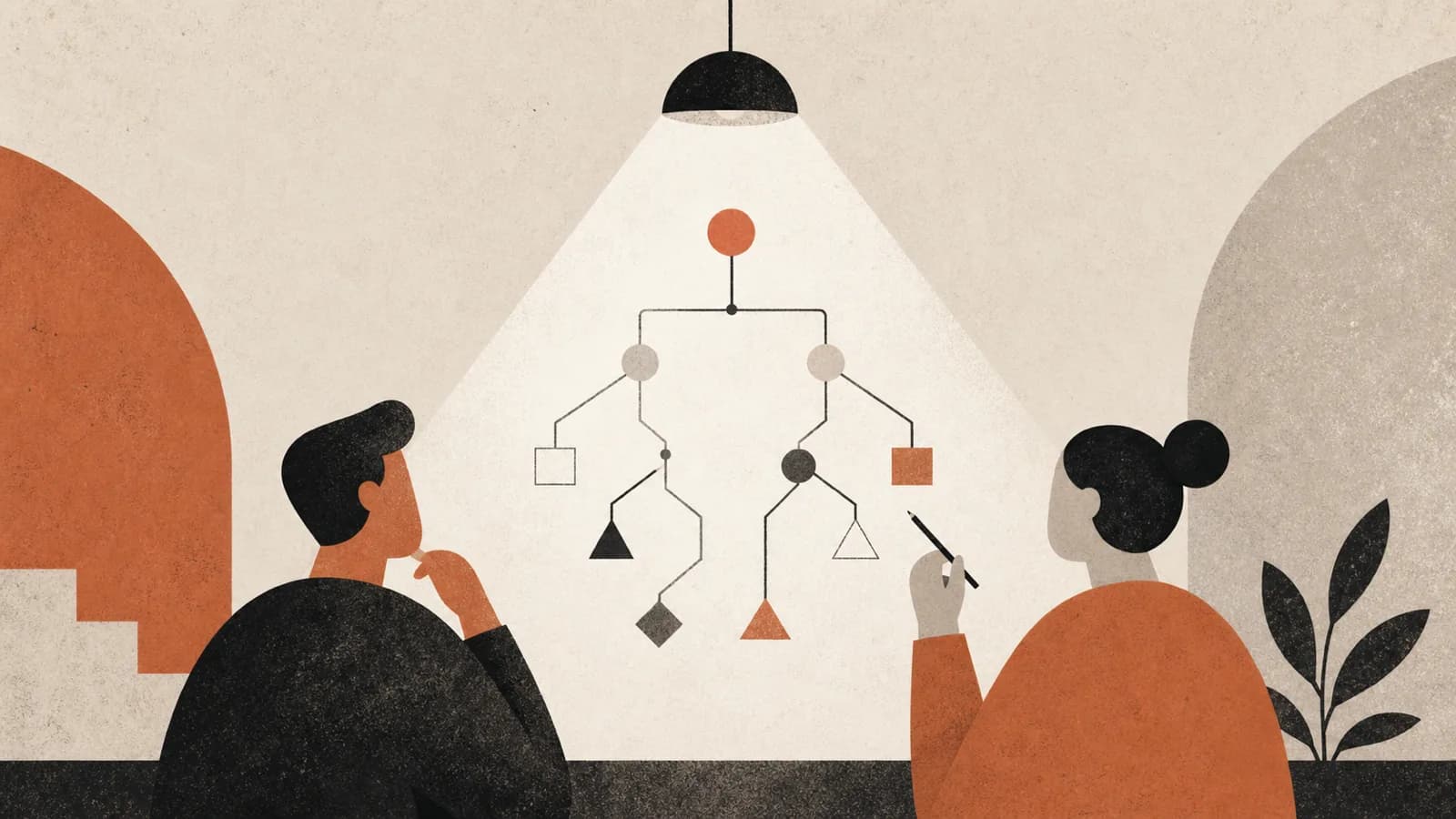
Matt Pocock's grill-me skill — a relentless interviewer prompt that walks down decision-tree branches one question at a time, with recommended answers — replaces "ask the agent for a plan" with "reach a shared understanding before any plan exists." The point is alignment, not output. The goal-state is what Frederick P. Brooks calls the design concept in The Design of Design: a shared idea held by all participants in the work. A PRD or a plan is downstream of the design concept; producing one without alignment first guarantees rework.
The skill (verbatim)#
"Interview me relentlessly about every aspect of this plan until we reach a shared understanding. Walk down each branch of the decision tree, resolving dependencies one by one. For each question provide your recommended answer. Ask the questions one at a time…"
That's it. The skill is short on purpose — minimum surface area, maximum behavior change.
Why grill before plan#
Pocock observed that agents in plan mode "really eagerly try to produce a plan" — say "I think I've got enough" and ship a plan that papers over open questions. The plan reads fine, but it is wrong in ways that don't surface until implementation. Forcing the agent to interview first exposes the open questions while there is still time to answer them cheaply.
The recommendation-with-each-question pattern is load-bearing: it lets the user say "yes, agreed" most of the time, only debating where they actually disagree. A pure question-only interview wastes user attention on obvious calls.
Counter to the "specs to code" movement#
Pocock's strongest negative thesis: specs-to-code is vibe coding by another name. Defenders say "write a careful spec, hand to AI, fix the spec when the code is wrong, never look at the code." Pocock has tried it: it doesn't work.
Reasons:
- The code is the battleground, not the spec
- Specs that don't engage with code degrade into wish-lists
- The feedback loop runs through a layer (spec ⇄ AI ⇄ code) instead of where the bugs actually live (code ⇄ tests)
- Without code engagement, the developer's mental model of the system rots
Grilling sits on the opposite discipline: spec is downstream of alignment, alignment is upstream of any artifact, the developer keeps a hand in the code throughout.
Outputs of a grilling session#
A grilling session can run anywhere from 10 to 100 questions; Pocock has had sessions that went an hour. The artifact at the end is the conversation history itself — kept around as raw material for the PRD step. Pocock's write-a-PRD skill consumes this history (along with another short interview) to produce a destination document.
He explicitly does not review the PRD afterwards:
"What am I testing at this point? What are the failure modes I'm trying to test for? I know that LLMs are great at summarization. I have reached the same wavelength as the LLM. So all I'm doing is checking the LLM's ability to summarize."
This is only safe because the grilling session did the alignment work. Skip grilling and you must read the PRD.
Two essential documents#
After grilling, Pocock generates exactly two documents:
- PRD (destination doc) — what the finished thing looks like, user stories, definition of done, out-of-scope list, implementation decisions, testing decisions, modules to be modified
- Kanban (journey doc) — vertical slices into independently grabbable tickets (see Vertical Slice Tracer Bullets)
He then deletes (or closes) the PRD after implementation completes — see doc rot.
Module map appears in the PRD#
The PRD includes "modules to be modified" — concrete identification of which existing modules change and which new ones are introduced. This connects planning to architecture (see Deep Modules for Agents). The point is to keep the codebase shape in mind throughout planning, not as an afterthought during implementation.
When to skip grilling#
Grilling is for human-in-the-loop tasks. For a short well-scoped change ("rename this function across the codebase"), the overhead is wasted. The discipline scales with stakes: bigger feature, fuzzier brief, higher cost of going the wrong way → grill harder.
Grilling used as a replacement for code review (September 2026)#
Orosz's survey of review practice (The Pragmatic Engineer, 2026-09-08, practitioner-opinion) reports /grill-me as "a popular method" for a third response to AI review volume: review the plan, the tests or the database schema instead of the implementation. Orosz says he is a fan of it for upfront planning. His quoted practitioner, Andrea Francesco Speziale (Principal Engineer, Musixmatch), states the stronger version: "After 3 hours of /grill-me, it better one-shot the implementation. I'm not spending a single minute on any review!"
This contradicts the skill's author, and on his central point. Pocock's argument above is that "write a careful spec, hand to AI, never look at the code" is vibe coding by another name: the code is the battleground, and the developer keeps a hand in it throughout. Grilling replaces reading the PRD, not reading the code. Speziale uses the same skill to justify the exact move Pocock rejects. Both positions are practitioner-opinion with no outcome data, so neither wins on evidence. What can be said is that the skill has spread faster than its framing: in the wild it is being adopted as an upstream substitute for review, which its author argued against. Orosz himself hedges the same way Pocock would, from a different angle. He thinks review-the-plan "makes perfect sense for a startup iterating to get product-market fit", but once there is a business, "you'll want to 'guard' the business logic with tests". The whole Martin objection (Spec-Driven Development as the New Waterfall) applies with extra force here: three hours of plan is exactly the heavy up-front commitment he reports failing.
Connections#
-
Spec-Driven Development as the New Waterfall — the objection this pattern survives: Martin's target is an executable plan the agent follows step by step, not the shared-understanding artifact grilling produces
-
Matt Pocock — author of the skill
-
Vertical Slice Tracer Bullets — the Kanban that follows the PRD
-
Deep Modules for Agents — module map in PRD ties planning to architecture
-
Agent Loop Pattern — grilling sits at the human-in-loop top of the funnel; loop drains the AFK bottom
-
Context Window Smart Zone — grilling uses sub-agents to keep parent context small
-
Agent Harness Engineering — "enforce invariants" at the planning layer is "reach alignment before any plan"
-
Claude Code Best Practices — the explore→plan→code workflow has the same shape; grill-me is the more aggressive variant of the "explore" step
-
Interaction Models — grilling is collaborative real-time iteration; turn-based interfaces are precisely what makes it clunky today, and an interaction model is the substrate that would make grilling-style collaboration feel native
-
HTML as the New Markdown — brainstorm → let Claude interview you → plan is the grilling shape; Thariq's HTML plan is a richer destination artifact than a markdown PRD, traded against harder versioning
-
Agentic Technical Debt — grilling produces the design concept that goes into CLAUDE.md; the strongest upstream defense against debt-by-session-re-derivation
-
Zero-Friction Scope Creep — a strong design concept reached via grilling resists scope sprawl in a way written PRDs alone often don't
-
Evals as Product Spec — grilling produces the design concept; evals encode whether it was achieved. Matt's "verification loops" and Cat's "ten great evals" are the same primitive at planning's other end
-
Building Is Cheap, Arguing Is Expensive — productive tension: Fiona Fung's "generate three PRs and compare" relocates design into built artifacts; reconciled here as the prototype is the medium of the design concept, not a replacement for reaching one
Open Questions#
- Can grilling be run AFK against another agent that holds the user's preferences? Pocock's answer in 2026 is "no, this part has to be human-in-the-loop" — but the question is open as agents get better at modeling their principal.
- How does grilling change for team work where multiple humans need to align? Pocock's hint: pair-program with the agent in the room, treat it as a third interlocutor.
Derived#
- The PRD-Replacement Spectrum at AI-Native Speed — the left pole of the spectrum: maximal pre-build alignment, PRD as deleted destination doc
- Where Does the Why Live? — the grilling session is an authoring-time home for the why; but the destination PRD that carries it is deleted, so the why is orphaned for future readers
- Is Persistence the Line Between Prompting and Spec-Driven Development? — this page as the under-inclusion case that breaks persistence-as-definition: the corpus's most specification-heavy position produces an ephemeral conversation as its artifact, and Pocock's own PRD is closed rather than deleted — authority revoked, file kept
Sources#
- Full Walkthrough: Workflow for AI Coding — Matt Pocock
- What is happening with code reviews? — Gergely Orosz, The Pragmatic Engineer, 2026-09-08,
practitioner-opinion, free portion only. Approach 3:/grill-meas a planning substitute for implementation review, the Speziale quote, Orosz's startup-versus-business caveat
Cited by 32
- The PRD-Replacement Spectrum at AI-Native Speed×7
Design Concept Grilling — the left pole: maximal pre-build alignment, PRD as deleted destination doc
- Where Does the Why Live?×6
The destination PRD · Held the why momentarily, then deleted after implementation — so the why dies…
- Learning to Co-Work with AI: A Software Engineer's Field Guide×5
What it is: reaching shared understanding (the "design concept" in Frederick Brooks's sense) before…
- Human-in-the-Loop Boundaries×4
Design Concept Grilling identifies the upstream loop that should remain human-heavy: before a plan,…
- Prototype Over PRD×4
Dan Carey's account of how the Claude Design team replaced product requirements documents with…
- Spec-Driven Development as the New Waterfall×4
Code As Source Of Truth and Committed Artifact Chain hold the opposite practice on the point he is…
- Is Persistence the Line Between Prompting and Spec-Driven Development?×3
The grilling transcript. Design Concept Grilling is the left pole of the PRD-replacement spectrum —…
- Unknowns as the Agentic Bottleneck×3
The wiki's existing planning discipline — grill first, then plan — assumes unknowns can be drained…
- Agent Loop Pattern×2
Amortize planning over many executions. One careful planning session (e.g. via Design Concept…
- Opinions on Using AI Tools & the Future of the Software Engineering Role×2
Specs-to-code is "vibe coding by another name." The code is the battleground, not the spec; reach a…
- Building Is Cheap, Arguing Is Expensive×2
This norm is in productive tension with the wiki's planning-first concepts. Design Concept Grilling…
- Claude Code Best Practices×2
A more aggressive variant: Design Concept Grilling (Matt Pocock's grill-me skill) replaces "ask the…
- Deep Modules for Agents×2
Design Concept Grilling — module map in the PRD operationalizes deep-module discipline at planning…
- Evals as Product Spec×2
Design Concept Grilling / Deep Modules For Agents — Matt Pocock's verification-loop framing; same…
- Matt Pocock×2
Grill, then plan, not plan, then read. Uses a relentless-interview skill (grill-me) to reach…
- Open Questions Backlog×2
Design Concept Grilling (152d) — How does grilling change for team work where multiple humans need…
- Playbook Boundary Conditions: the Devil's-Advocate Substrate and the Prototype's Edge×2
Cross-team coordination — the artifact aligns the people in the room with it (the pitch-off); a…
- Agent Harness Engineering
Design Concept Grilling — alignment-layer harness primitive; prevents premature plan generation by…
- Agentic Technical Debt
Design Concept Grilling — Matt Pocock's grill-me pattern reaches a Brooks "design concept" before…
- Configurable Human Participation
Design Concept Grilling — agent-initiated clarification scored by the Clarification Quality Score…
- Context Window Smart Zone
Design Concept Grilling — the grilling session uses a sub-agent so the parent context stays small
- HTML as the New Markdown
Design Concept Grilling — brainstorm → let Claude interview you → plan is the grilling shape; the…
- Interaction Models
Design Concept Grilling — collaborative, real-time iteration over spec-and-walk-away; an…
- LLM-as-Compiler Knowledge Base
Design Concept Grilling — Brooks's "design concept" (shared understanding before any artifact) is…
- AI Coding Practice
Design Concept Grilling (hub) — Matt Pocock's grill-me skill; reach Brooks "design concept" before…
- Model Introspection Feedback
Design Concept Grilling — the inverse: model interviews user. Same pattern, opposite direction.…
- Model Spec Midtraining (MSM)
Product spec (Symphony, Design Concept Grilling): humans + agents read the spec to align on…
- Outsource Your Thinking, Not Your Understanding
Design Concept Grilling — reaching the Brooks "design concept" before planning is forcing…
- Rationale as a Dated Record: Where the Why Lives for the Next Reader
The closed issue · the PRD kept after implementation with its authority revoked · One…
- Turn-Based Interface Bottleneck
Design Concept Grilling — argues the value is in collaborative iteration; this page argues the…
- Vertical Slice Tracer Bullets
Design Concept Grilling — the slice list comes out of the PRD that comes out of the grilling session
- Zero-Friction Scope Creep
Design Concept Grilling — Matt Pocock's grill-me pattern as upstream defense (a strong design…
Related articles
- Harness Shrinkage as Models Improve
Prompt scaffolding shrinks each model release; Cat Wu's pruning discipline; Boris Cherny "100 lines of code a year from…
- Deep Modules for Agents
Ousterhout deep-vs-shallow modules applied to agent-friendly codebases; push-vs-pull instruction delivery; reviewer in…
- Context Window Smart Zone
Smart zone vs dumb zone (Dex Horthy / Matt Pocock): quadratic attention scaling, ~100K marker independent of advertised…
- Matt Pocock
Independent AI-coding educator; built Sandcastle library; smart-zone/grill-me/tracer-bullets pedagogical framing; "bad…
- Claude Code
Anthropic's agentic coding product; created by Boris Cherny late 2024; TypeScript/React on Bun (itself Claude-rewritten…