Sources#
- HAS-Bench: Evaluating LLM-Based Human-Agent Systems under Configurable Human Participation
- Voice AI in Firms: A Natural Field Experiment on Automated Job Interviews
Summary#
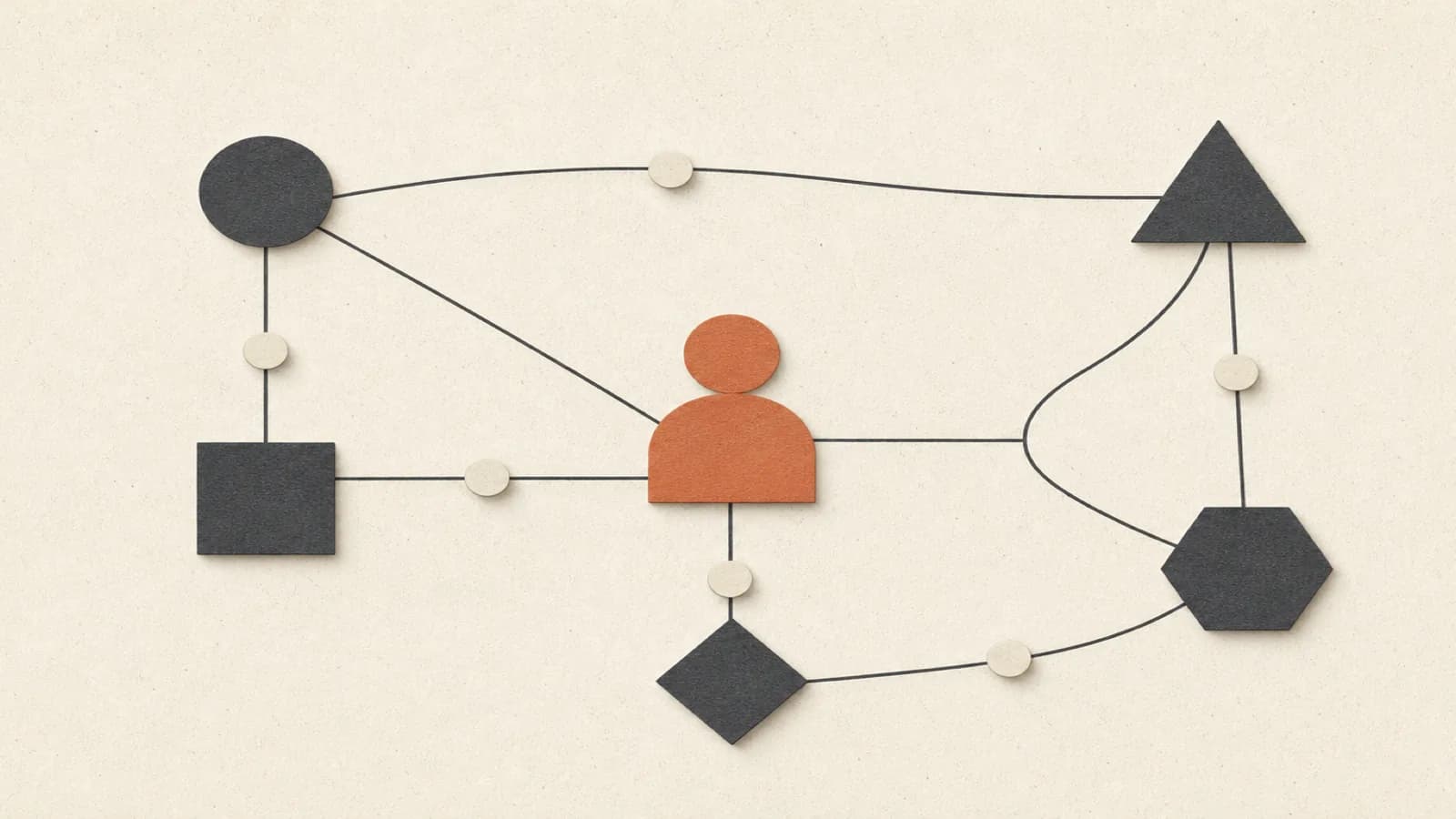
HAS-Bench (Wu, Huang, Guo et al., 14 authors across Tokyo / UIC / MBZUAI / McGill / Zhejiang, arXiv 2607.04329, July 2026) is the first benchmark that treats human participation as a controlled experimental variable rather than a fixed backdrop. It sits on HAS-Framework, a graph-based execution framework in which humans and LLM-powered agents are first-class nodes in one shared interaction graph — each with explicit roles, permissions, communication paths, and action authority — so a human is not a late-stage "approve/reject" supervisor bolted onto the outside but a designable, schedulable participant the scenario routes work to.
The central move: factor human involvement into orthogonal, ablatable knobs, then measure what turning each knob does — to outcomes and to the process of collaboration. The headline empirical result is a bottleneck-relocation for how we think about human-in-the-loop: human participation substantially helps, but its value is configuration-dependent, not monotonic in how much you add. "An agent must decide not only what action to take, but also when to ask for input and how to incorporate it from different human collaborators."
Evidence note.
empirical— a controlled benchmark, but the "human" is an LLM user-simulator (GPT-4.1 by default) and GPT-4.1 is also the default judge; a robustness study swaps in Claude-Sonnet-4 / DeepSeek-V3 / GPT-4.1-mini as alternative simulators (Appendix C.6). So this measures configured, simulated participation on 397 verifiable tasks — it informs the shape of returns to human input, but it is not field telemetry of real human oversight load. Read every number below with that substitution in mind.
The three configuration axes#
Participation is varied along three independent axes, each a first-class scenario setting:
1. Agency level — the Human Agency Scale (A1–A5) (adopted from Shao et al. 2025 / Zou et al. 2025). A1 Full Automation → A2 Minimal Input → A3 Equal Partnership (the default) → A4 Agent-Assisted → A5 Human-Driven. A1–A2 are automation-oriented (agent replaces most human effort); A3–A5 are augmentation-oriented (human retains meaningful involvement). Each level maps to a concrete runtime policy: agent prompt, which channels are open, trigger conditions, and who holds authority over decisions and actions. The main experiments sweep A1 / A3 / A4 (A2 is a near-A1 variant, A5 reduces the agent to a typist).
2. Interaction channel — clarification, feedback, control. The paper's cleanest conceptual contribution: a generic "human input" is split into three functions distinguished by what they act on and when:
- Clarification acts on input, before the agent commits — resolve missing / ambiguous / conflicting / underspecified information before a plan or tool call.
- Feedback acts on output, after an intermediate artifact exists — evaluate, correct, or refine a plan, partial result, or generated artifact.
- Control acts on action — approve, veto, modify, override, take over, or directly execute (especially for protected, safety-sensitive, or human-only-permission actions).
Each channel can be agent-initiated (the agent asks) or human-initiated (the human volunteers). This turns "was there a human in the loop" into traceable, ablatable events.
3. Persona. With task, model, agency level, permissions, and private information all held fixed, the persona varies how the human tends to interact (each domain defines three).
The benchmark#
397 tasks across six domains, built by adapting verifiable tasks from τ²-bench and MultiAgentBench and injecting interaction requirements (2,749 raw source tasks → 301 base → 397 after LLM-panel adaptation + majority-vote review + sampled human verification):
- Service-oriented (stateful tools, domain policy): Retail (94), Telecom (100), Airline (31).
- Open-ended expert (iterative refinement / verification): Coding (115), Research (30).
- Negotiation: Bargaining (27).
Each task is tagged with one of six problem patterns that define its interaction requirement: Information Asymmetry (107), Latent Constraint (114), Safety-Critical Authorization (35), Multi-Stakeholder Specification (62), Iterative Verification (61), Dynamic Goal Revision (18).
Process-aware metrics are the other half of the contribution — HAS-Bench scores not just whether the task succeeded but how collaboration unfolded. Outcome: pass@1, Task Score (partial credit), Delivery Rate, Safety Rate, HAS Rescue Rate (fraction of autonomy-failures recovered once a human joins). Process: Clarification Quality Score, Feedback Utilization Rate, Control Request Justification, Action Safety Rate, Initiative Entropy, Human Intervention Rate (HIR), plus raw interaction cost (turns, tool calls, human steps, tokens). Agent backbones: GPT-4.1, GPT-4.1-mini, Claude-Sonnet-4, DeepSeek-V3-0324, Llama-3.1-8B.
The four findings#
RQ1 — Participation helps, but only if the agent can use it. Averaged over models, Equal Partnership (A3) beats Full Automation (A1) by +8.4 Pass@1 and +11.5 Task Score, and lifts Safety Rate on the safety-critical subset by +26.9 points. Capable agents gain most: GPT-4.1 +16.9 / +20.5, GPT-4.1-mini +13.7 / +19.2; the peak per-domain cell is GPT-4.1 on Research (Pass@1 13.3→66.7, Task Score +36.7, rescue rate 65.4%). But the effect is heterogeneous and not a universal switch: Llama-3.1-8B gains ≈0 (−0.2 Pass@1, +0.5 Task Score, 0.5% rescue). Crucially, larger gains do not track higher human-intervention rate — value is contingent on the agent's capacity to operationalize input, not the amount supplied. Two mirror-image failure modes make this concrete:
- Premature self-completion (Claude-Sonnet-4 on Research): delivers a proposal on 86.7% of tasks but uses the least human input of any cell (HIR 10.9%) and commits below the acceptance bar — it doesn't engage the human it has.
- Capability floor (Llama-3.1-8B on Coding): heavy human input (HIR 41.4%) but only 35.7% delivery and zero Pass@1 gain — human help can't substitute for a missing capability.
RQ2 — Diminishing and sometimes negative returns to more agency. Sweeping A1→A3→A4 (GPT-4.1, Coding + Research), outcomes rise but the curve bends: Coding Pass@1 39.1→52.2→63.5, Research 13.3→66.7→70.0 (a giant A1→A3 jump, a small A3→A4 one). The sharp result is at the task level: going A3→A4 rescues 27 tasks but breaks 13 that A3 had solved (Coding 19 rescued / 6 broken; Research a fragile 8 / 7). The broken cases are classified as premature interventions or redundant/distracting inputs. "The key issue is not simply granting more human agency, but exercising agency at the right time and in the right form."
RQ3 — Different problem patterns need different channels. Isolating single channels (clarification-only / feedback-only / control-only vs. all):
- Clarification wins on Information Asymmetry and Latent Constraint — surface hidden facts / acceptance criteria before committing.
- Feedback wins on Multi-Stakeholder Specification, Iterative Verification, Dynamic Goal Revision — repair, reconcile, or adapt after an intermediate output exists.
- Control-only reaches 100% Safety Rate on Safety-Critical Authorization (vs. 51 clarification / 54 feedback) — clarification and feedback cannot substitute for explicit authorization over protected actions.
- The timing distinction is the mechanism: clarification acts before commitment, feedback repairs after. On Latent Constraint, clarification (29) beats feedback (17) precisely because hidden acceptance criteria are cheaper to elicit before the agent picks a candidate.
- More channels is not better: in 5 of 6 patterns the best single channel beats enabling all of them (Dynamic Goal Revision is the lone exception). Extra channels add redundancy, mistimed interaction, and coordination overhead rather than monotonically improving collaboration.
RQ4 — Personas move outcomes without moving the intervention rate. Holding everything else fixed and varying only interaction style: outcomes swing hard in open-ended/negotiation domains (Bargaining Pass@1 range 63.0 pts, Research 33.4, Coding 21.8) yet HIR ranges stay ≤0.04. Personas don't change how much the human participates; they change how — the same agent asks 3.77 more/fewer clarification questions in Bargaining, 1.97 in Telecom. Persona effects hide if you only measure final success, which is exactly why the process-level metrics exist.
Why this matters: participation is a policy, not a dial#
The unifying claim across all four RQs: a fixed participation policy is insufficient. The value of human input is a configuration — a joint choice of when (timing: before-commit vs after-output), how (channel: clarify / feedback / control), how much (agency level), and by whom (persona / capability) — and the optimum is task-pattern-specific and non-monotonic. More authority, more channels, and more intervention can each reduce performance. This is a benchmark-side, empirically-measured version of the design intuition that shows up qualitatively across the corpus: keeping a human "in the loop" is only valuable when the loop is shaped right.
The field counterpart: one configuration, 67,056 real humans#
HAS-Bench sweeps many configurations against a simulated human on 397 tasks. Jabarian & Henkel's hiring experiment is the opposite trade: one configuration, randomized across 67,056 real people with administrative outcomes. Read in this page's vocabulary, the configuration is unusually legible — and it is not the A3 sweet spot:
- Agency level: A1 within the stage, A5 across it. The agent conducts the interview with no human participation inside the conversation (full automation of information collection); the human then holds complete authority over the decision. Not "equal partnership" but a clean stage boundary — automate one stage entirely, keep the next entirely human.
- Channel: control only, exercised after. No clarification, no mid-task feedback. The human's single act is authorization over the consequential action (extend an offer or not), on the basis of an artifact the agent produced — the Control channel, applied to the one decision that matters.
- Result: it works, and the human stage becomes the queue. 12% more job offers, ~18% more job starts and one-month retention, no productivity decline. And median interview→offer-decision time rises 2.62 → 7.24 days, because reviewing a conversation you did not conduct is slower than having had it.
Two things this adds. First, it corroborates RQ3's sharpest finding from the field: on a consequential-authorization pattern, control-only is sufficient, and the cheaper channels were never needed. Second, it exposes a cost the benchmark cannot price — HAS-Bench measures interaction cost in turns, tool calls, and tokens, all of which the human's waiting time is invisible to. Here the control channel's real cost is a 2.8× longer human review stage, and it is large enough to make end-to-end throughput worse (20 → 24 days) even as quality improves. A configuration that wins on outcome can lose on latency, and only field measurement sees it.
Where the benchmark's warning does replicate: the human evaluators discount the signal they are given, weighting the AI-produced interview score significantly less in their decision while weighting an independent test score more. "The agent must decide how to incorporate human input" has a mirror image nobody benchmarks — the human must decide how to incorporate the agent's, and by default they under-trust it.
Connections#
- Procedural Value in AI Decisions — the same configuration sweep scored on a different objective. HAS-Bench ranks human-participation configurations by task outcomes; a preregistered conjoint (n=1,919 US job seekers) ranks them by what the affected party will accept, and the two need not agree: subjects price who holds final authority (+0.272) above every add-on feature, prefer "AI suggests, human decides" to "AI screens first, human decides" by 0.030 (p<0.001) because only the former lets a human see the rejected cases, and value an appeal route (+0.156) at more than twice a system-level bias audit (+0.068). Both pages land on "the configuration is what matters, not the amount of human" — the open question the pair raises is whose preferences a participation design is optimizing
- Crystallizing Agent Work into Workflows — the engineering form of this page's central move. Making human review a typed, durable event (
HumanReviewRequested→ workflow persists for minutes or days →HumanReviewCompleted) is what turns participation from a fail-safe outside the system into a measurable variable inside it: agreements, disagreements and edits all become logged data that feeds the next eval set. Same instinct, opposite starting point — a benchmark sweeping configurations against a simulated human, versus a runtime making one configuration addressable in production — and each supplies what the other lacks (a measured optimum, versus the mechanism to observe where a real deployment actually sits) - Controlled Variance: AI's Edge as Reduced Dispersion — the field counterpart above: one fixed configuration (agent automates the stage, human holds all decision authority, control channel only) randomized across 67,056 real applicants with administrative outcomes, where the benchmark sweeps many configurations against a simulated human on 397 tasks
- Parallel Agent Orchestration — its open question ("what is the human's actual oversight load per concurrent agent, and where does it saturate?") gets reframed here: this benchmark finds the value of human input is a configuration sweet spot (right timing/form/authority), not a monotonic dial — more agency (A4) yields diminishing and sometimes negative returns. But it is single-human, single-task, LLM-simulated, so it sharpens the shape of the question (non-monotonic, not linear) without measuring real per-agent load.
- Planning / Execution Division of Labor — the finer-grained version of "humans decide what, agents decide how": clarification is planning-time input, feedback/control are execution-time input, and the paper shows which is worth exercising is pattern-dependent — the division of labor is a schedule, not a fixed split.
- Human-AI Accountability Redesign — the agency-level (A1–A5) and control-channel axes are the benchmark instrument for that page's decision-rights / escalation subfront; Safety-Critical Authorization (control-only = 100% safe) is the measured case that authorization can't be delegated to clarification or feedback.
- Claude Code Auto Mode — the Control channel and Safety-Critical Authorization pattern are exactly the auto-approve-safe / gate-risky decision-rights design, now with a number: control-only authorization closes the protected-action safety gap where clarification/feedback (51/54%) cannot.
- Interaction Models — the channel-and-timing taxonomy (clarify-before-commit, feedback-after, mixed initiative) is the task-benchmark companion to TML's architecture answer for keeping humans in the loop; both argue participation must be designed, not defaulted.
- Turn-Based Interface Bottleneck — HAS-Framework's typed edges and agent/human-initiated channels are what a non-single-thread interface would route; the finding that agent-initiated clarification quality varies is the interface bottleneck measured as an outcome.
- Unknowns as the Agentic Bottleneck — "clarification acts before commitment" is the eliciting-unknowns move measured: HAS-Bench quantifies that clarification specifically wins the Information-Asymmetry / Latent-Constraint patterns (hidden knowns), and that the agent deciding when to ask is the skill.
- AI Brain Fry — the interaction-cost metrics (turns / human steps / tokens) and the "more channels ≠ better" result are the participation-side of oversight cost: over-asking and mistimed intervention have measured costs, so more human involvement is not free.
- Agent Harness Engineering — HAS-Framework is a harness whose explicit design goal is making human participation schedulable; the RQ2/RQ3 findings are a harness-design result — when to solicit input and which channel to open is a scaffolding decision, not just a model capability.
- Experimental Learning Impact of Generative AI — the human-learning mirror, published the same week: the same augmentation-vs-automation axis (there: the student's use mode; here: the agency level's orientation) causally decides whether AI involvement produces durable value or hollow output — both refute the monotonic "more input is better" dial.
- Measuring Beyond Accuracy Saturation — the field counterpart to this benchmark's controlled human-agent measurement: HAS-Bench varies participation on an LLM-simulated human across 397 tasks; Nadgir et al. run a real randomized study on 20 reproduction tasks and find agent collaboration more than halves completion time (2.11×, p≈0.002). Both make human-agent collaboration a first-class measured axis — a simulated-vs-real pairing on the same question.
- AI-Moderated Interviews: Adaptive Probing, Human Rapport, and Digital Twins — direct evidence on how an LLM standing in for a specific human diverges from that human, which is this benchmark's standing caveat. Digital twins conditioned on each person's interview reason more analytically than the person on every task (Gemini and GPT-5-mini alike), and they draw on biographical context where the person reacts to the stimulus. That is a different task from HAS-Bench's user simulator, so it names a likely bias direction rather than measuring this benchmark's
Into hubs (one-way)#
- Verification as the New Bottleneck — the Feedback channel (evaluate/correct intermediate output) and Iterative Verification pattern are human verification measured as a lever; feedback wins exactly the verify-and-refine patterns.
- Design Concept Grilling — agent-initiated clarification scored by the Clarification Quality Score (precise, necessary, non-redundant) is
grill-meinverted — the agent interviewing the human — and the paper measures whether it over-asks. - Context Smells — Houck's specification ambiguity smell is the case this benchmark's clarification channel is for: agents ask on an obviously underdetermined request, but on a semi-ambiguous one they pick a reading and proceed, which is the when-to-ask judgment HAS-Bench finds load-bearing
Open Questions#
- The "human" is an LLM simulator (GPT-4.1) that also judges — how much of the configuration-dependent structure is a property of human-agent collaboration versus an artifact of GPT-4.1 modeling both sides? The Appendix C.6 simulator-swap is the only check, on a subset.
- A4 is instantiated as a fixed one-shot proactive intervention. Real proactive humans time their input adaptively — does the "premature/distracting intervention breaks tasks" result hold, worsen, or vanish under a human who chooses when to interject?
- The optimal channel is shown to be pattern-specific, but pattern is an oracle label assigned at construction. Can an agent infer which pattern it is in (and thus which channel to solicit) at runtime — the actual deployed skill the paper says agents lack?
- Does the "more channels adds coordination overhead" penalty shrink as the backbone improves (a capability gap), or is it a structural cost of mixed-initiative interaction that persists?
Sources#
- Voice AI in Firms: A Natural Field Experiment on Automated Job Interviews — Jabarian & Henkel, Voice AI in Firms (arXiv 2607.28222, 2026-07-30;
empirical, pre-registered RCT): §2.4 (the fixed configuration — AI conducts, human decides), §3.1 (outcomes), §6.2 (the human under-trusting the agent's signal), §7.1 (the latency cost of the control channel). Parse warnings and full treatment at Controlled Variance: AI's Edge as Reduced Dispersion. - HAS-Bench: Evaluating LLM-Based Human-Agent Systems under Configurable Human Participation — Wu et al., arXiv 2607.04329 (2026-07-05). §3 HAS-Framework (graph, channels, agency scale); §4 benchmark construction + metrics; §5.2 main results (RQ1 value, RQ2 agency sweep); §5.3 ablations (RQ3 channels × patterns, RQ4 personas). Figures 1 (framework overview + airline A1/A3/A4 walkthrough) and 2 (agency-level Coding/Research plots) viewed.
Cited by 21
- Bind, Don't Forbid; Prevent, Don't Detect: The Action-Open and Poisoned-Memory Residuals×2
When binding starves the task, the system elicits specification — clarification-before-commit, the…
- Context Smells×2
Configurable Human Participation: HAS-Bench measures the repair loop in reverse, an agent choosing…
- Crystallizing Agent Work into Workflows×2
Human review is an event, not an exception. The naive shape (pause the process, send an email, hope…
- Open Questions Backlog×2
Configurable Human Participation ×3 (oldest 81d) — The "human" is an LLM simulator (GPT-4.1) that…
- The Orchestrator's Real Workload: Decision Burden, Framing Discipline, and Whether Taste Scales×2
The workflow side gained measured backing. Decision-rights gating — the reconciliation's central…
- Parallel Agent Orchestration×2
Summed-overlap runtime can exceed 24h/day — it measures agent effort, not human attention. What is…
- Agent Harness Engineering
Configurable Human Participation — HAS-Framework is a harness whose explicit goal is making human…
- AI Brain Fry
Configurable Human Participation — the participation-cost side: HAS-Bench's interaction-cost…
- AI-Moderated Interviews: Adaptive Probing, Human Rapport, and Digital Twins
Configurable Human Participation — HAS-Bench's "human" is an LLM user-simulator. The twin results…
- Claude Code Auto Mode
Configurable Human Participation — HAS-Bench's Control channel + Safety-Critical Authorization…
- Controlled Variance: AI's Edge as Reduced Dispersion
Configurable Human Participation — the field counterpart to HAS-Bench's controlled sweep. HAS-Bench…
- Experimental Learning Impact of Generative AI
Configurable Human Participation — the system-side mirror, published the same week: HAS-Bench's…
- Human-AI Accountability Redesign
Benchmark instrument: Configurable Human Participation — HAS-Bench's Human Agency Scale (A1–A5) and…
- Is Human Review of AI-Authored Code Still a Real Control, or Already Rubber-Stamping?
But the failure mode is a threshold, not a destiny — the countermeasures are also in evidence. What…
- Interaction Models
Configurable Human Participation — the task-benchmark companion to this architecture answer:…
- Measuring Beyond Accuracy Saturation
Configurable Human Participation — the human-uplift study is the field counterpart to HAS-Bench's…
- AI Coding Practice
Configurable Human Participation — HAS-Bench (Wu et al.): human participation as a configurable…
- Planning / Execution Division of Labor
Configurable Human Participation — the finer-grained schedule under "humans decide what, agents…
- Procedural Value in AI Decisions
Configurable Human Participation — HAS-Bench treats human participation as a configurable variable…
- Turn-Based Interface Bottleneck
Configurable Human Participation — HAS-Framework's typed human/agent-initiated channels are what an…
- Unknowns as the Agentic Bottleneck
Configurable Human Participation — "clarification acts before commitment" measured: HAS-Bench finds…
Related articles
- Harness Shrinkage as Models Improve
Prompt scaffolding shrinks each model release; Cat Wu's pruning discipline; Boris Cherny "100 lines of code a year from…
- Open Questions Backlog
Generated by `_system/lint.py --write-backlog`. Do not hand-edit. Domain and Watching sections carry one row per page —…
- Verification as the New Bottleneck
Fiona Fung: coding is no longer the bottleneck — verification, review, maintenance are; shift-left; TDD loses its tax;…
- AI Brain Fry
Kropp et al. 2026/03: mental fatigue from excessive AI oversight increases minor errors +11%, major errors +39%; cognit…
- Loop Engineering
Replacing yourself as the agent's prompter by designing the system that prompts it: a recursive-goal loop built from fi…