Sources#
- Claude Opus 5 System Card
- DHH: Future of Programming, AI, Agentic Engineering, Vibe Coding & Linux | Lex Fridman Podcast #501
- Do Context Files Help Coding Agents? A Two-Agent Ablation Study on Real Repositories
- From Agent Behaviour to Agent-Friendly Documentation
- From Registry to Repository: How AI Agent Skills Are Written, Adapted, and Maintained
- OpenAI Codex lead on the new shape of product work
- The Founder's Playbook: Building an AI-Native Startup
- Uncle Bob on Software Fundamentals in the Age of AI
- Who Maintains Agent Skills? A Longitudinal Study of Human-Governed, AI-Assisted Skill Maintenance
Summary#
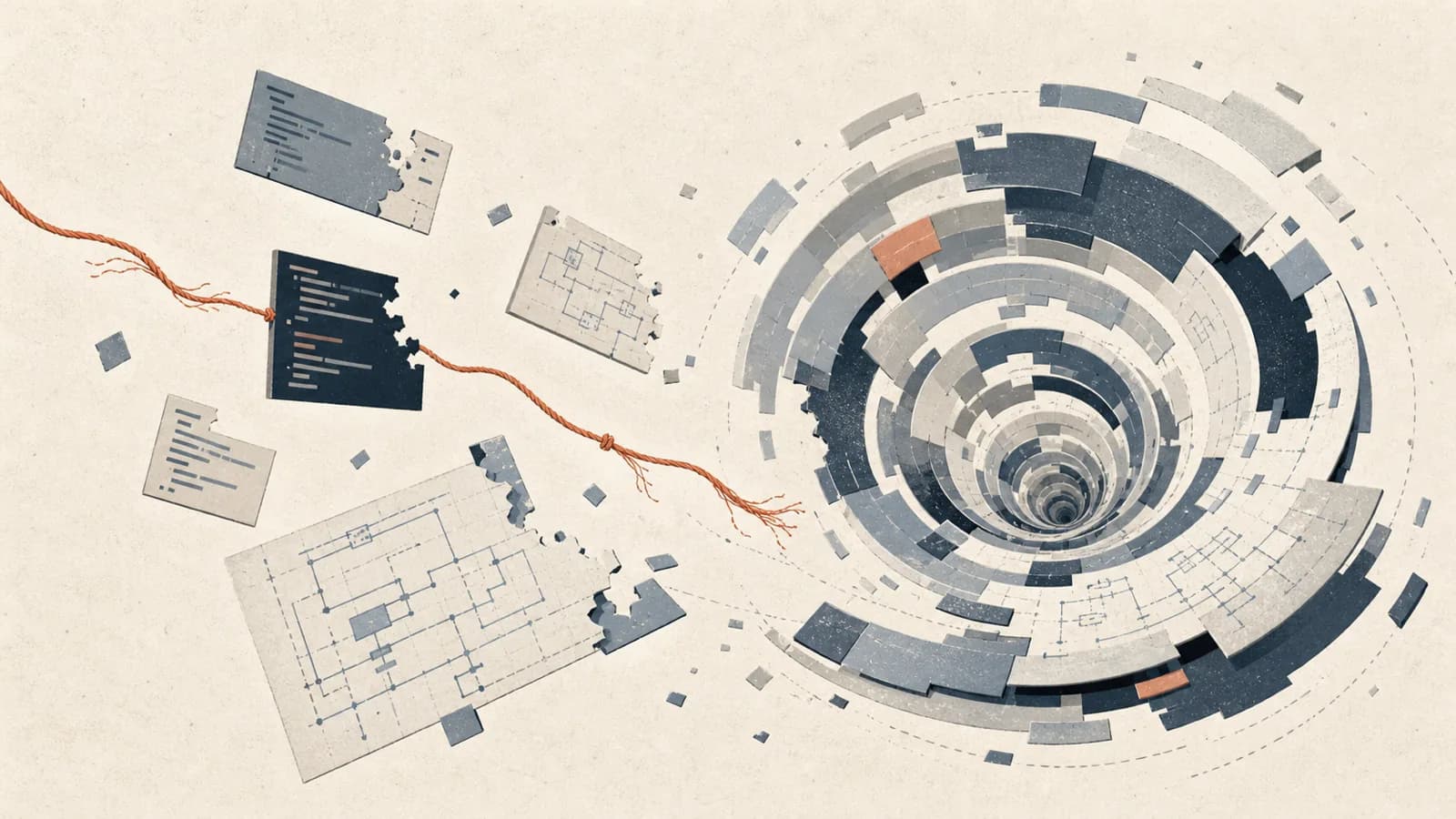
A specific failure mode of AI-built codebases articulated in The Founder's Playbook: Building an AI-Native Startup: technical debt that compounds rather than accumulates linearly, because each agentic-coding session re-derives foundational architectural decisions from scratch when no persistent specs or context files exist. The result is a codebase that is functional in pieces but has "no coherent mental model behind it, not because any single piece is bad, but because the pieces were never designed to fit together." The problem tends to surface late — the codebase runs fine until iteration or scale forces a full rewrite.
Why this is different from ordinary technical debt#
Ordinary debt accumulates gradually and can be cleared in a dedicated sprint. Engineers know the shortcuts they took and where; the work is bounded.
Agentic technical debt has three structurally novel properties:
- Drift, not just shortcut. Each session's "first principles" reasoning lands in a slightly different place. The codebase doesn't just contain compromises; it contains inconsistencies between compromises.
- Invisible until it isn't. A working feature does not advertise the architectural premise it was built against. The drift is observable only by reading the whole codebase, which the founder typically isn't doing because they're shipping.
- No natural feedback loop. A traditional engineering team has shared design conversations, code review, ADRs — all of which create human memory of "why this way." A solo founder + agent has neither, so each session genuinely starts from zero on intent.
The mechanism#
"Without specs and architectural constraints written down somewhere the AI can read, each session re-derives foundational decisions from scratch, and those decisions drift."
Each agentic session begins with the agent inferring its own structural assumptions from the current code state. Two sessions reading the same code can infer two different intents (was this pattern intentional? Was that abstraction a constraint or a coincidence?). The agent then builds the next feature against its inferred intent. Repeat over months and the codebase contains multiple "implicit architectures" interleaved.
The remedy: persistent context#
The playbook's prescription is to encode architectural intent in CLAUDE.md markdown files that Claude Code automatically reads at the start of every session. These files serve as project-level instructions — functionally persistent "memory" for the project. The discipline:
- Before opening Claude Code, open Claude (chat) and define what you're building: core problem, users, six-month scale, architectural principles, dependencies to avoid, tradeoffs being consciously accepted. Save as CLAUDE.md.
- Start each Claude Code session by (1) revisiting the scope document and (2) providing the model with the CLAUDE.md context document.
- End each session by updating CLAUDE.md with any decisions the session surfaced.
The playbook's claim: "Five minutes of documentation per session is cheap insurance against architectural drift that compounds into an unmanageable codebase." (Qualified 2026-08-05 — see "What the remedy was measured to buy" below: the insurance is real for cost and process discipline, unevidenced for per-task correctness.)
What the remedy was measured to buy (Khatri, July 2026)#
The prescription above has never been tested in this corpus; Khatri 2026 (arXiv 2607.27250, empirical) is the first controlled ablation of it, and the result cuts a specific way. Across 288 gold-test-evaluated runs on two frontier agents and three real repositories, removing the context file entirely does not lower task correctness (Claude 53.3% with no context vs 55.6% with; Codex 58.8% vs 56.9%; differences bounded <10–15pp), and the real AGENTS.md never converts a near-miss failure into a pass in a 36-cell probe. The mechanism is the load-bearing part: the near-misses fail on implementation skill — a precision bug in a correctly-designed optimization, a reactive-retry pattern chosen where proactive refresh was needed, a rule the agent read off the code and then miswired — not on architectural intent a file could have carried. Full treatment on Agent Context Files.
Three things this does and does not change here:
- It does not touch the drift claim. Khatri measures single-session task correctness against a hidden test oracle. This page's mechanism is cross-session — inconsistencies between compromises accumulating over months, surfacing as a forced rewrite. A per-task pass rate cannot observe that; the experimental design that would (repeated sessions on one codebase, coherence measured at the end) does not exist in the corpus.
- It does narrow the claimed payoff to a channel the playbook doesn't name. What survived the ablation was a process effect with a dose-dependent mechanism: on the one repository whose file warns that the full test suite takes >20 minutes, the agent's blind full-suite runs fall 3.67 → 2.44 → 1.67 as context is delivered more selectively, and wall-clock drops ~24%. That is the "cheap insurance" premise vindicated on token and latency cost — which is precisely the currency the rebuild-from-scratch argument below trades in — while leaving the correctness half unevidenced.
- It sharpens what belongs in the file. The gotchas discipline (Agent Context Files) and the "prune what the agent can infer from the code" rule both survive intact and are, on this evidence, the only content with a demonstrated return: the one file that paid was the one carrying a fact about the environment (test-suite cost) that no amount of reading the repository would surface. Architectural principles and style conventions — the playbook's headline content — are exactly what the ablation found inert.
When the debt matures#
The playbook flags two moments when ordinary AI-built debt becomes a structural liability:
- MVP → Launch transition. Production traffic, new features, and growing complexity expose shortcuts. "That debt starts accruing interest, and the longer it goes unaddressed, the more expensive it is to fix."
- Pre-enterprise audit. Enterprise contracts surface compliance requirements (SOC 2, GDPR, HIPAA) that didn't apply to a prototype. AI scans help but are explicitly not a substitute for qualified compliance review.
The Launch-stage remedy is a systematic architectural audit (Claude Code finds structural weaknesses, test-coverage gaps, refactoring candidates) → Claude triages and sequences remediation → CLAUDE.md is updated with the architectural decisions that lived only in the founder's head during MVP.
The "rebuild from scratch" failure mode#
"Letting Claude Code build without guardrails produces a codebase that will be functional but structurally incoherent, and iterating on and scaling incoherent codebases is ultimately a waste of time and tokens. Sooner or later there's a point where the code inevitably collapses, forcing you to rebuild from scratch."
The economic argument: iterating on incoherent code costs more tokens (longer context, more re-reading, more clarification) than maintaining a coherent codebase from the start. The cost is not principally human time — it's compute. Founders chasing zero-cost iteration trade present minutes for future cost-of-rewrite.
The complexity ratchet: models add, rarely delete (Ambrosino)#
The founder's-playbook account is about drift (each session re-derives intent differently). Andrew Ambrosino (OpenAI Codex) names a second, orthogonal mechanism from the frontier-lab side: models increase complexity by default and are bad at deleting code.
"One thing all models suffer with right now is they usually increase complexity. If research is listening at any company — please make the models better at deleting code."
This is a directional bias, not just inconsistency: left to run, an agent adds abstraction, guards, and code faster than it removes them, so complexity ratchets upward every session. It's the specific barrier Ambrosino cites to putting development "completely on autopilot" (unsupervised loops) — he floats "coming in overnight and doing garbage collection of the codebase to clean it up" as a wished-for capability precisely because the default drift is toward more code, not less. Where the playbook's remedy is persistent context (fight drift), the frontier problem is a missing capability (models can't reliably simplify). Both must be solved before autonomous development is trustworthy; a first-party frontier lab reports the deletion gap as unsolved.
The same ratchet runs in the context layer, and it is measured. From Registry to Repository: How AI Agent Skills Are Written, Adapted, and Maintained (empirical) hand-codes 444 SKILL.md diffs across 5,876 GitHub repos: excluding in-place edits, additions outnumber removals 2.7:1 overall and 6.1:1 for skills evolving in place after local authorship (adoption-time customisation is near-balanced at 1.1:1, since adopters prune what doesn't apply). Developers keep appending verification steps, prohibitions, and best-practice recommendations; the only content routinely deleted is the upstream registry's licence and authorship metadata. So the artefact meant to prevent re-derivation debt (skills) accrues the same monotonic growth as the code — while simultaneously going stale: 53% of reused skills are never modified after adoption, and the largest single evolution activity is chasing renames and tooling substitutions (24.3% of diffs) as the surrounding project restructures underneath the skill. The debt is sharper than stale documentation because an agent doesn't read around an inconsistency — it executes it.
And on the skills that are maintained, the ratchet is the same shape. Gao et al. sample the whole population, most of it untouched; Shen & Hruschka (empirical, 2026-09) select five public vendor repositories for sustained activity and code all 254 substantive SKILL.md edits by dominant purpose: 60% enhancement, 38% correction, and consolidation plus deprecation 11 of 254 (4.3%) — one retirement in eight months across 143 skills. Size trajectories are stable-to-additive (of 120 skills with two or more observations, 32 grow >10%, 7 shrink, 81 hold), on a 5-day median edit cadence, and every edit is authored or merged through a named human account with an AI co-author trailer on 62%. So a human on every merge does not change the direction: the maintained core accretes exactly as the abandoned periphery does, and the authors' first design implication for automated curators is an explicit pruning budget. Their transfer-task test adds the uncomfortable coda for this page's remedy — six-plus rounds of maintenance produced skill versions no better than the first (−0.09 on a 1–5 scale, CI [−0.28, +0.10]) — so the upkeep that fights drift has no measured payoff yet either. Full treatment on Human-Governed Skill Maintenance.
The first-hand instance at a company with no prior debt (37signals, February 2026)#
DHH reports this page's mechanism happening to Basecamp, at a company whose whole public identity is architectural restraint (Lex Fridman #501, 2026-08-26, practitioner-opinion). During the Basecamp 5 sprint 37signals concluded implementation was solved and handed product work to non-programmers:
"We had this early surge of, 'It's solved. We can just have the designers do the programming. They know what features they want. They know what shape they want it to take. Let them vibe.' And we let them vibe. And we ended up with a lot of PRs that individually perhaps could have been justified for a hot moment, but taken all together, destroyed the architecture of the system. And we actually had to clean up manually, mop it up by hand, by human hand, to get back to an architecture that felt cohesive and coherent."
Three things make this a useful data point rather than an anecdote. It is per-PR-defensible drift, not per-PR badness — the exact signature this page's "inconsistencies between compromises" describes, observed by someone who was looking for it. The remedy was human, months into the agentic era, at a shop with strong conventions and a small team. And DHH independently reproduces the stacking mechanism outside that incident: "the first PR is, like, mediocre of quality, and then if you add another PR on top of that, and then five more down the line, it's not very good."
His generalization is the constraint worth carrying: you must already be a programmer "to be able to vibe code on existing substantial code bases, even if they're CRUD, if you wanna retain the element of architecture that got that system to where it was." Greenfield work in the same three months — his Omarchy distro — reached 100% agent-written code without the failure; Basecamp and Hey "have proven surprisingly tricky to fully accelerate with agents." Nobody has isolated which variable (codebase age, user count, coherence) carries that split.
The threshold, watched rather than inferred (Martin, December 2025)#
This page's mechanism is usually argued from outcomes — a forced rewrite, a mop-up, drifting PRs. Robert C. Martin reports watching it happen inside a single session, at the point where the debt starts charging the agent rather than the team (Uncle Bob on Software Fundamentals in the Age of AI, 2026-08-19, practitioner-opinion). Starting with an early Grok agent around December 2025, he deliberately did not clean up between tasks:
"It would leave all this mess around and instead of cleaning the mess, I would have it do the next thing and it would leave even more mess around… And I noticed it slowing down. It would change one thing but inadvertently break another and then it would have to fix that but inadvertently break another. Started going around in circles."
He reports the terminal state as an outright abandonment — an agent saying, in his paraphrase, "I just can't deal with this anymore."
Two contributions to this page:
- A threshold model rather than a linear-accrual model. "They are as subject as humans are to messy code. Now maybe not as subject. Maybe there's a difference in threshold, but the threshold is still there. The code can get messy enough that the agents cannot deal with it any longer and then they'll just start to spin and make a mess even worse." If the debt has a cliff rather than a slope, the observable signal is not gradually worse output but a sudden change in the agent's own behaviour — thrash, oscillating fixes, giving up. That is a cheaper early indicator than any architectural review, and it is the one Martin says he actually used.
- It is why he does not read the code. Asked how he knew the agents were making mistakes in December, he distinguishes the two signals sharply: "Early on I was just looking at the code and seeing the dog doo. That wasn't the important part. The important part was the next step where I watched them thrash." He then names the transfer problem this creates for anyone who has not been through it themselves: "one of the issues is the novice would come in and not recognize the struggle" (Returns to Expertise in Agentic Coding).
His remedy is not persistent context but a must-pass gate stack that keeps the mess below the threshold in the first place (Reviving Impractical Quality Tools) — a different answer from this page's CLAUDE.md program, aimed at the same mechanism. Neither is measured against the other.
Connections#
-
Agent Documentation Behavior — the co-evolution measurement this page's remedy presumes. Agents do maintain documentation — 41.5% of 33,097 agentic PRs change it, high against the human comment-maintenance literature — but the order is the debt-shaped part: among the 4,386 multi-commit PRs where order is observable, code is touched first 4.7× more often than documentation, and 82.5% of the time when the two land in different commits. The persistent-context remedy below is therefore running behind the code it is supposed to describe by construction, not by neglect
-
Spec-Driven Development as the New Waterfall — what accumulates if you take the cheap-change argument without the gate stack that makes it safe
-
Community Smells Under AI Adoption — this debt's team-level shadow: across five structural models the only path pointing at harm is information governance (AI adoption → worse documentation and informal information flow, β = −.194, marginal at p =.069)
-
Unproductive Self-Verification — how the debt gets written: unrequested refactors, extra tests, and speculative verification pipelines that read as productivity, observed across Opus 5's training transcripts
-
AI-Native Startup Lifecycle — primary MVP and Launch-stage hazard
-
Deep Modules for Agents — Ousterhout-style deep modules + persistent-context discipline are the architectural counter-pressure; Matt Pocock's Sandcastle pattern is one concrete instance
-
Agent Context Files — the cross-vendor pattern this page's remedy is one instance of, and where the Khatri ablation is treated in full: the correctness return on generic convention content is bounded near zero, the measured return is on cost and process
-
Claude Code Best Practices — official Anthropic guidance on CLAUDE.md; the playbook frames the same discipline as founder survival, not best practice
-
Claude Code — the tool where this debt accumulates
-
Zero-Friction Scope Creep — companion failure mode; scope creep accrues debt faster
-
Harness Shrinkage as Models Improve — counter-pressure: if the harness (including session-context plumbing) shrinks, CLAUDE.md may need to evolve too
-
Context Window Smart Zone — CLAUDE.md must fit in the smart zone; over-long context files become their own problem
-
Design Concept Grilling — Matt Pocock's grill-me pattern reaches a Brooks "design concept" before code, complementary to CLAUDE.md-as-architectural-context
-
Founder as Agent Orchestrator — non-technical founder pipeline raises the stakes: the founders most able to identify problems are least equipped to author the architectural context that prevents this debt
-
Problem-Solution Fit Discipline — the twin MVP-stage hazard; epistemic discipline (validate before building) and architectural discipline (persist context before building) are both load-bearing
-
Agentic Work Systematization — un-systematized agent use is the re-derive-from-zero / intent-debt failure mode; skills are the persistent-context antidote — but rotting, unmaintained skills are themselves a debt surface as conventions drift
-
Unknowns as the Agentic Bottleneck —
implementation-notes.mdwith aDeviationslog is intent debt paid down in-flight: the agent records the edge cases that forced it off the plan, so the next session doesn't re-derive them -
Code as Source of Truth — Fiona Fung's positive program against this debt: check specs/skills into the repo so context stays current and Claude can verify spec drift, instead of each session re-deriving it
-
Harness Shrinkage as Models Improve — CLAUDE.md is a harness asset that may eventually be inferred; until then, persistent context is the antidote to compounding debt
-
Founder as Agent Orchestrator — the recursion problem: non-technical founders may lack the vocabulary to write effective CLAUDE.md
-
Loop Engineering — Osmani's intent debt is the same compounding-drift mechanism viewed from the loop: without skills a loop "re-derives your whole project from zero every cycle," each session filling intent gaps with a confident guess; skills (intent written outside) are the antidote, exactly as CLAUDE.md is here
-
Outsource Your Thinking, Not Your Understanding — the cognitive twin: comprehension debt (the gap between code-that-exists and what-you-understand) is this architectural debt in the understanding register, and both compound at agentic-coding speed
-
Acceleration Whiplash — the same compounding mechanism measured at industry scale; Faros AI's "context engine" (intent derived from how the codebase evolved, not its current state) is the org-scale version of the CLAUDE.md remedy
-
AI as Primary Author — an AI author with no persistent intent re-derives architecture each session; this debt is the structural cost of that authorship/accountability gap
-
Andrew Ambrosino — the frontier-lab report of the complexity-ratchet: models add code, are bad at deleting, blocking unsupervised development
-
Vibe Coding vs. Agentic Engineering — the deletion gap is why "loops are so last week" hasn't yet reached fully-unsupervised autonomous development
-
Harness Build-vs-Buy — the other debt that arrives with coding agents, and a different mechanism entirely: not intent drift inside your own code but vendor-branch divergence from someone else's, accruing at ~13 upstream PRs/day from other people's velocity. Same maturity profile (invisible until a forced rebase or a forced rewrite), unrelated cause — don't read its PR counts as evidence about agent-authored code quality
-
Security Debt of Agent-Generated Code — the security register of the same debt, measured: it accrues in the CI/container plumbing (87.6% of smells sit in GitHub Actions workflows and Dockerfiles) that no session's architectural context covers, and stays invisible until a credential is exploited rather than until a rewrite is forced
-
Agent-Generated Test Quality — "stealth technical debt" in the test suite: agent tests reach the disk and non-deterministic APIs at ~1.4× the human rate, so the suite passes today and costs CI reliability later — the same advertise-nothing property as a working feature that hides its architectural premise, and a debt that accrues in the environment rather than the architecture. The coverage cut on that page is this page's mechanism stated in the testing register by the source itself: untested code paths "create technical debt that accumulates silently until regression failures emerge in production," and it is measured — 50.4% of code-changing agentic PRs carry no test change and existing tests reach 27.0% of changed lines in Python. A working feature advertises nothing about its architectural premise; a green suite advertises nothing about whether it touched the diff
-
Review as the Control Point — comprehension debt is this architectural debt's cognitive twin in the CMU code-review theory: low review depth + code opacity accrue it, and it feeds reinforcing loops that erode maintainability, ownership, and future review skill — and it accrues even when review depth stays high ("tasting the dish, not reading the recipe")
-
Efficiency Debt of AI-Generated Code — the same missing-context mechanism denominated in compute: AI-generated C++ writes ~2x the explicit loops and 30-40% fewer standard-library calls, which lands as ~5% relative compute and ~8% relative memory overhead in production. Two things make it this page's sibling rather than a separate topic. The paper's own hypothesis for the cause is "generalist LLMs lacking the highly specific context of internal enterprise monorepo structures," and its proposed fix is a knowledge base injecting that context at prompt time — the CLAUDE.md remedy reached independently from profiling data, and unlike the Khatri ablation it has a measured payoff (an 11.1% reduction in targeted findings). It also names the debt's maturity moment: this one never forces a rewrite, it just bills more every month
-
Prototype Fidelity After Cheap Polish — Boehm's 1988 "spaghetti code difficulties" is this page's argument in its original form, and the reason evolutionary prototyping never worked; whether GenAI resolves it or automates the same mistake is the fork this page's evidence answers
-
The Code-Quality Payoff Is Token-Indexed — DHH's economic frame for the same phenomenon: architectural coherence pays because agents otherwise re-derive context, which makes this debt's cost a function of the token budget rather than of human comprehension
-
Open Source Under Agent Contributions — the same drift arriving from outside the team: an unbounded supply of individually-passing external PRs, triaged by agents
-
Robert C. Martin (Uncle Bob) — the practitioner who watched the threshold get crossed in-session and rebuilt his workflow around never approaching it
-
Reviving Impractical Quality Tools — the gate-stack remedy: keep the mess below the agent's threshold mechanically rather than documenting the architecture
-
Human-Governed Skill Maintenance — the ratchet measured on the maintained core rather than the abandoned periphery: 254 human-released
SKILL.mdedits, one deprecation, ten consolidations, 60/38 enhancement/correction — and no measured payoff from the maintenance either -
Context Smells — lost in the details is this page's mechanism named as a context smell: implementation detail with none of the reasoning behind it, which Houck ties to Margaret-Anne Storey's intent debt (rationale disappearing from the artifacts a system leaves behind)
-
Follow-Up Fixes on Agent PRs — the debt surfacing per PR: within a repository, a merge that took ten times the commits has 6.1× the odds of needing a verified fix later, and the agent that wrote it usually writes the fix. The repair loop keeps no human insider, which this page's persistent-context remedy assumes exists
Open Questions#
- How long does a CLAUDE.md remain accurate as a codebase evolves? The playbook gestures at session-by-session updates; no data on rot rate. (Partially answered — not answered — by Khatri 2026: rot rate is still unmeasured, but the question's stakes move. If a Good/Excellent-rated file buys no correctness over having none, then a stale file costs correspondingly little correctness too, and the rot that matters is in the environment-fact content (test cost, deployment invariants) that carried the one measured effect. The measurement still owed is a longitudinal one: does a file's accuracy decay track anything observable in agent behaviour?) (Repair cadence, not rot rate, measured 2026-09-22 by Who Maintains Agent Skills? A Longitudinal Study of Human-Governed, AI-Assisted Skill Maintenance on the sibling artefact: actively maintained public
SKILL.mdfiles are touched every 5 days at the median and 38% of substantive edits are corrections — factual corrections and fixes from observed failures — with concrete failure evidence on 24% of edits under the primary coding pass and 63% under a cross-family recode. That is how often maintained skills get repaired, not how fast unmaintained ones decay, and the same paper's transfer-task null (latest version −0.09 vs earliest, CI [−0.28, +0.10]) says the repairs bought nothing measurable — Khatri's stakes-deflation from the other side.) - The remedy assumes the founder is able to articulate architecture in plain language. Non-technical founders (the playbook's headline beneficiary group) may have neither the vocabulary nor the intuition to do this well — a recursion failure the playbook doesn't address. (Deflated, not resolved, by Khatri 2026 — if the file doesn't move correctness, the founder's inability to write a good one costs less than this bullet assumes; see Founder as Agent Orchestrator.)
- Anthropic's harness-shrinkage thesis suggests CLAUDE.md may eventually be inferred by the model itself. Until then, the discipline is load-bearing.
Sources#
-
From Agent Behaviour to Agent-Friendly Documentation — Gao & Chen (Peking University), arXiv 2608.20195, 2026-08-20,
empirical. Cited here for §4.3 (41.5% of 33,097 AIDev PRs change documentation, repository-cluster CI 35.8–45.4%; code first in 47.3% of 4,386 orderable multi-commit PRs against 10.0% documentation-first, and 82.5% when the two land in different commits) and §2.3's comparison against the human co-change literature. Merge-rate figures are not cited — the repository-clustered intervals overlap and the authors draw no conclusion. Full treatment on Agent Documentation Behavior -
DHH: Future of Programming, AI, Agentic Engineering, Vibe Coding & Linux | Lex Fridman Podcast #501 — DHH, Lex Fridman #501 (2026-08-26,
practitioner-opinion): the Basecamp 5 designer-vibe-coding architecture failure and the hand mop-up; PR-stacking drift reproduced in 37signals codebases -
The Founder's Playbook: Building an AI-Native Startup — MVP Stage and Launch Stage chapters
-
OpenAI Codex lead on the new shape of product work — Ambrosino: "models usually increase complexity… please make the models better at deleting code"
-
From Registry to Repository: How AI Agent Skills Are Written, Adapted, and Maintained — Gao et al., arXiv 2607.00911 (
empirical): §VII-A additive-maintenance asymmetry (2.7:1 overall, 6.1:1 in evolution); §VI-A 53% of reused skills never modified after adoption -
Who Maintains Agent Skills? A Longitudinal Study of Human-Governed, AI-Assisted Skill Maintenance — Shen & Hruschka (Megagon Labs), arXiv 2609.05677, 2026-09-04,
empirical: §4 + Appendix C operation distribution (consolidation 10, deprecation 1 of 254), §5 + Figure 4 size trajectories and cadence, §6 governance, §7 the transfer-task null. Full treatment on Human-Governed Skill Maintenance -
Do Context Files Help Coding Agents? A Two-Agent Ablation Study on Real Repositories — Prakhar Khatri, arXiv 2607.27250, 2026-07-28 (
empirical, sole author, not peer reviewed): the first controlled ablation of the CLAUDE.md/AGENTS.md remedy — Table 1 flat pass-rates across NONE/ALWAYS ON/SELECTIVE on both agents, §5.1 the implementation-skill-not-knowledge failure triage, §5.2 the manipulation probe (the real file never flips a near-miss), Table 2 the full-suite-test-run dose effect. Bounded null, not a powered equivalence claim (MDE >30pp at n=17); scoped to single-session task correctness, so it does not test this page's cross-session drift mechanism. Two of the paper's five tables are cell-collapsed in the raw — figures here are quoted from prose (Raw re-parsed 2026-09-05 with docling 2.126: the Table 3 task-row weld is repaired; the residualtable-collapsehits are repeated pass-count triples, not merged rows — see the note on Agent Context Files.) -
Uncle Bob on Software Fundamentals in the Age of AI — Robert C. Martin with Matt Pocock, 2026-08-19 (
practitioner-opinion; auto-caption transcript): the in-session threshold account — thrash, oscillating fixes, and an agent abandoning the task — plus the claim that watching the agent struggle, not reading its output, is the usable early signal
Cited by 44
- AI-Native Startup Lifecycle×6
Goal: smallest, most-focused iteration that puts the solution in front of real users and generates…
- How AI-Native Startups Avoid Speed Becoming Strategic Debt×5
The wiki has a technical version already: Agentic Technical Debt compounds when each agentic coding…
- Acceleration Whiplash×3
This is a productive refinement of Verification As The New Bottleneck: Faros agrees verification is…
- Agentic Work Systematization×3
Agentic Technical Debt — un-systematized agent use is the re-derive-from-zero / intent-debt failure…
- The Code-Quality Payoff Is Token-Indexed×3
Basecamp 5, February 2026. 37signals let designers vibe-code product work directly: "we had this…
- Efficiency Debt of AI-Generated Code×3
They converge on one characterization: the agent handles the code under consideration competently…
- Loop Engineering×3
Comprehension rots if you let it. The faster the loop ships code you didn't write, the bigger the…
- Open Questions Backlog×3
Agentic Technical Debt: The remedy assumes the founder is able to articulate architecture in plain…
- Addy Osmani×2
Intent debt — an agent starts every session cold and fills any gap in your intent with a confident…
- AI as Primary Author×2
Agentic Technical Debt — an author with no persistent intent re-derives architecture each session;…
- Claude Code Best Practices×2
CLAUDE.md: persistent instructions loaded every session. Include only what Claude can't infer from…
- Code as Source of Truth×2
Agentic Technical Debt — the debt that compounds when context isn't persisted in the repo; this is…
- Community Smells Under AI Adoption×2
Agentic Technical Debt — the Information Sharing result is this debt's team-level shadow: the one…
- Context Smells×2
Agentic Technical Debt: lost in the details is the debt's mechanism. Storey's intent debt and the…
- Harness Build-vs-Buy×2
Agentic Technical Debt — the debt-family sibling with a different mechanism: intent drift inside…
- Human-Governed Skill Maintenance×2
Pruning is nearly absent. Consolidation (10) and deprecation (1) together are 4.3% of edits (11 of…
- Prototype Fidelity After Cheap Polish×2
This vault can already say which fork the evidence points down, and the article does not know it.…
- Robert C. Martin (Uncle Bob)×2
He reports an agent giving up outright — "I just can't deal with this anymore," paraphrased. This…
- Unknowns as the Agentic Bottleneck×2
implementation-notes.md — a temporary file the agent maintains, logging the decisions it made and,…
- Vibe Coding vs. Agentic Engineering×2
Agentic Technical Debt — the barrier to fully-unsupervised loops Ambrosino names: models increase…
- Zero-Friction Scope Creep×2
Pre-agentic scope creep was self-policing. Engineering time was visible, scarce, and rateable; "we…
- Agent Context Files
Agentic Technical Debt — the founder-side case for this pattern (persistent context as the antidote…
- Agent Documentation Behavior
Agentic Technical Debt — the co-change half: 41.5% of agentic PRs change documentation, high…
- Agent-Generated Test Quality
Agentic Technical Debt — "stealth technical debt" is this page's register of the same compounding…
- Anthropic
Agentic Technical Debt — Anthropic's named MVP-stage technical hazard
- Claude Code
Agentic Technical Debt — failure mode specific to Claude Code use without persistent CLAUDE.md…
- Context Window Smart Zone
Agentic Technical Debt — founders' persistent-context discipline (CLAUDE.md) competes with…
- Deep Modules for Agents
Agentic Technical Debt — deep modules + persistent CLAUDE.md context together are the architectural…
- Design Concept Grilling
Agentic Technical Debt — grilling produces the design concept that goes into CLAUDE.md; the…
- Follow-Up Fixes on Agent PRs
Agentic Technical Debt — merges that took many commits are the ones that draw fixes (6.1× per…
- Founder as Agent Orchestrator
The playbook claims non-technical founders can now build production software, but it does not…
- Harness Shrinkage as Models Improve
Agentic Technical Debt — CLAUDE.md as architectural context is one form of harness; may eventually…
- Matt Pocock
Agentic Technical Debt — his deep-modules + grill-me + Sandcastle stack is the…
- Startup & Founder
Agentic Technical Debt — Debt that compounds (not just accumulates) because each agentic-coding…
- Open Source Under Agent Contributions
Agentic Technical Debt — what an unbounded supply of individually-passing external PRs does to an…
- Orchestration vs Employee Framing: Reconciling the Founder's Playbook with HBR's Accountability Evidence
The error surface is real. Playbook flags it via Agentic Technical Debt, Zero Friction Scope Creep,…
- Outsource Your Thinking, Not Your Understanding
Comprehension debt — "the faster the loop ships code you did not write, the bigger the gap between…
- Problem-Solution Fit Discipline
Agentic Technical Debt — companion technical hazard; the playbook treats epistemics and…
- Returns to Expertise in Agentic Coding
What makes this more than a training anecdote is the specific skill he says the gauntlet teaches,…
- Review as the Control Point
Agentic Technical Debt — comprehension debt is the cognitive twin of architectural drift; both…
- Reviving Impractical Quality Tools
Agentic Technical Debt — the failure mode the revived tools are aimed at
- Security Debt of Agent-Generated Code
Agentic Technical Debt — security debt as a sibling of architectural debt: it accrues in the…
- Spec-Driven Development as the New Waterfall
Agentic Technical Debt — what accumulates if you fiddle without the gates
- Unproductive Self-Verification
Agentic Technical Debt — unrequested refactors, extra files, and speculative tests are how an agent…
Related articles
- Verification as the New Bottleneck
Fiona Fung: coding is no longer the bottleneck — verification, review, maintenance are; shift-left; TDD loses its tax;…
- Open Questions Backlog
Generated by `_system/lint.py --write-backlog`. Do not hand-edit. Domain and Watching sections carry one row per page —…
- Claude Code
Anthropic's agentic coding product; created by Boris Cherny late 2024; TypeScript/React on Bun (itself Claude-rewritten…
- Harness Shrinkage as Models Improve
Prompt scaffolding shrinks each model release; Cat Wu's pruning discipline; Boris Cherny "100 lines of code a year from…
- Vibe Coding vs. Agentic Engineering
Vibe coding raises the floor (anyone builds); agentic engineering preserves the quality bar while going faster; ">10x a…