Sources#
Summary#
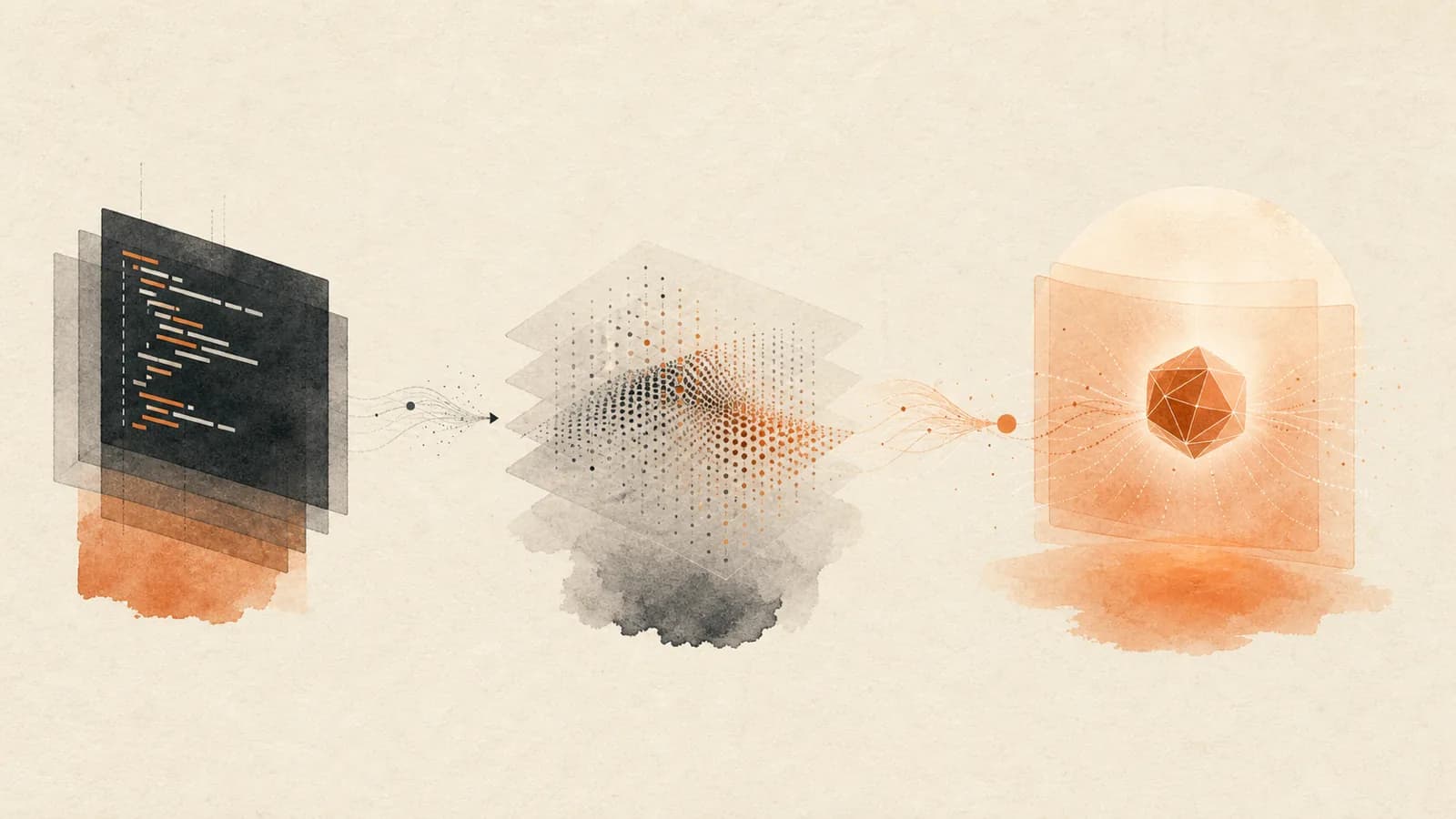
Andrej Karpathy's taxonomy of three programming paradigms: Software 1.0 is explicit code; Software 2.0 is learned weights (you program by curating datasets, objectives, and architectures); Software 3.0 is prompting — the LLM is a programmable computer and "what's in the context window is your lever over the interpreter." Trained on the whole internet, the model implicitly multitasks every task in the data, becoming a general interpreter that performs computation in digital-information space. The deeper claim: 3.0 doesn't just make old programs faster, it makes whole classes of programs unnecessary — and enables information-processing tasks that couldn't exist before.
The three paradigms#
| Software 1.0 | Software 2.0 | Software 3.0 | |
|---|---|---|---|
| You write | Code | Datasets + objectives + architectures | Prompts / context |
| Executed by | CPU | Trained neural net | LLM as interpreter |
| The "program" is | Source | Weights | The context window |
The OpenClaw installer example#
Installing a complex cross-platform tool used to mean a shell script that "balloons up and becomes extremely complex" to target every environment — Software 1.0 thinking. The 3.0 version: the install instructions are a block of text you copy-paste to your agent. The agent packages its own intelligence, inspects your machine, performs intelligent actions, and debugs in the loop. "What is the piece of text to copy-paste to your agent? That's the programming paradigm now." (See Agent-Native Infrastructure for the generalization.)
MenuGen: the app that shouldn't exist#
Karpathy built MenuGen — photograph a menu, OCR the items, generate images of each dish — as a real Vercel app with image-gen plumbing. Then he saw the 3.0 version: hand the photo to Gemini and say "use Nano Banana to overlay the dishes onto the menu," and the model returns the exact menu image with rendered dish pictures in the pixels. "All of my menu gen is spurious. That app shouldn't exist." The neural net subsumes the entire application; the prompt is just the image, the output is just the image, no app in between.
Beyond code: new information-processing tasks#
A subtler point: previous code operated over structured data. Software 3.0 enables operations that were never programs at all. His example is the LLM wiki: "there was no code that would create a knowledge base from a bunch of facts. Now you can take these documents and recompile them in a different way… something new as a reframing of the data." He calls this "more exciting" than mere speedup — not what we can do faster, but what couldn't be done before.
The extrapolation: neural net as host process#
Pushed to the limit: a "completely neural computer" — raw video/audio in, diffusion rendering a UI unique to that moment, the neural net as the host process and CPUs as the co-processor for deterministic appendages. He frames this as the 1950s–60s fork (calculator vs. neural net) flipping back: classical computing won the first round, neural nets are currently virtualized on it, and that relationship may invert. This is The Bitter Lesson taken to its architectural conclusion. He hedges that the path there is "TBD."
Connections#
- Compute Allocator — deciding what's worth compute is the human role in a 3.0 stack
- Andrej Karpathy — originated the taxonomy
- Agent-Native Infrastructure — the OpenClaw "copy-paste to your agent" install is the practical face of 3.0
- Vibe Coding vs. Agentic Engineering — vibe coding is 3.0 with the floor lowered; agentic engineering is 3.0 done at professional quality
- AI as Primary Author — programming-in-English is the paradigm in which an AI can be the author of most code at all
- LLM-as-Compiler Knowledge Base — his canonical "new task that wasn't a program before" example
- The Bitter Lesson — the neural-net-as-host-process extrapolation is Sutton's principle pushed to the hardware layer
- The Verifiability Thesis — explains which 3.0 tasks work today (the verifiable ones)
- HTML as the New Markdown — Thariq Shihipar's "build a throwaway UI per task" is a 3.0-native workflow; Disposable Micro-Apps are MenuGen-style apps-that-barely-exist
- Interaction Models — Thinking Machines' "diffusion-rendered UI / neural computer" direction is a concrete step toward the host-process extrapolation
- Universal AI (AIXI) — a paradigm-level cousin of "pretraining as resource-bounded universal compression"; both push the same general-method-over-structure logic to its theoretical floor
- Latent vs. Deterministic Space — Tan's practitioner rule for the open question below: put judgment in the model, state and constraints in code; MenuGen is the canonical wrong-side-of-the-boundary bug
- OpenClaw — the installer example's subject, now with its own entity page
Open Questions#
- Where is the line between "the app shouldn't exist" (MenuGen) and apps that should — i.e., when is deterministic 1.0/2.0 scaffolding still the right call vs. spurious?
- The neural-net-as-host-process flip is presented as plausible-but-TBD. What would the first production system that genuinely inverts the CPU/NN relationship look like?
Sources#
Cited by 17
- Agent-Native Infrastructure×2
The concrete seed (shared with Software 3 0): installing OpenClaw isn't a shell script, it's a…
- Andrej Karpathy×2
Software 3 0 — prompting/context as the program; the LLM as a programmable interpreter.
- Latent vs. Deterministic Space×2
Software 3 0 — Karpathy's paradigm frame for the same boundary; his MenuGen example is the inverse…
- Open Questions Backlog×2
Software 3 0: The neural-net-as-host-process flip is presented as plausible-but-TBD. What would the…
- OpenClaw×2
The canonical agent-native install. Karpathy's go-to example of Software 3 0 / Agent Native…
- AI as Primary Author
Software 3 0 — programming-in-English is the paradigm in which an AI can be the author at all
- Compute Allocator
Software 3 0 — MenuGen ("that app shouldn't exist") is allocation in action: deciding the neural…
- Disposable Micro-Apps
Software 3 0 — micro-apps are Software-3.0-native: Karpathy's MenuGen "that app shouldn't exist" is…
- HTML as the New Markdown
Software 3 0 — HTML-first plans and Disposable Micro Apps are Software-3.0-native: per-task UIs…
- Interaction Models
Software 3 0 — Karpathy frames interaction models as a step toward the 3.0 neural-computer
- LLM-as-Compiler Knowledge Base
Software 3 0 — Karpathy's canonical example of a "new information-processing task that wasn't a…
- Model Capability & Training
Software 3 0 — Karpathy's taxonomy: 1.0 code, 2.0 weights, 3.0 prompting; LLM as programmable…
- OpenAI
OpenAI is an AI research company and the maker of the GPT‑5 series (including GPT‑5 Thinking and…
- Thariq Shihipar
Software 3 0 — his HTML-first workflows and Disposable Micro Apps are Software-3.0-native: per-task…
- The Bitter Lesson
Software 3 0 — the neural-net-as-host-process extrapolation is the bitter lesson pushed all the way…
- Universal AI (AIXI)
Software 3 0 — Karpathy's "neural net as host process" is a paradigm-level cousin of "pretraining…
- Vibe Coding vs. Agentic Engineering
Vibe coding raises the floor (anyone builds); agentic engineering preserves the quality bar while going faster; ">10x a…
Related articles
- Harness Shrinkage as Models Improve
Prompt scaffolding shrinks each model release; Cat Wu's pruning discipline; Boris Cherny "100 lines of code a year from…
- Agent Harness Engineering
Patterns for scaffolding long-running LLM agents: environment design, progressive context disclosure, mechanical archit…
- Andrej Karpathy
Co-founder OpenAI, ex-Tesla AI, Eureka Labs; coined "vibe coding," Software 1/2/3.0, "ghosts not animals," "agentic eng…
- Claude Code
Anthropic's agentic coding product; created by Boris Cherny late 2024; TypeScript/React on Bun (itself Claude-rewritten…
- Compute Allocator
The human's evolving role: deciding what's worth spending compute on; ~1% of generated tokens ship, 99% is scaffolding…