Sources#
- Garry Tan: Own Your Intelligence
- Indian AI Coding Startup Emergent Becomes a Unicorn with $130M Series C
- The New Physics of Business — Garry Tan, Y Combinator
- The State of Agent Wikis
Summary#
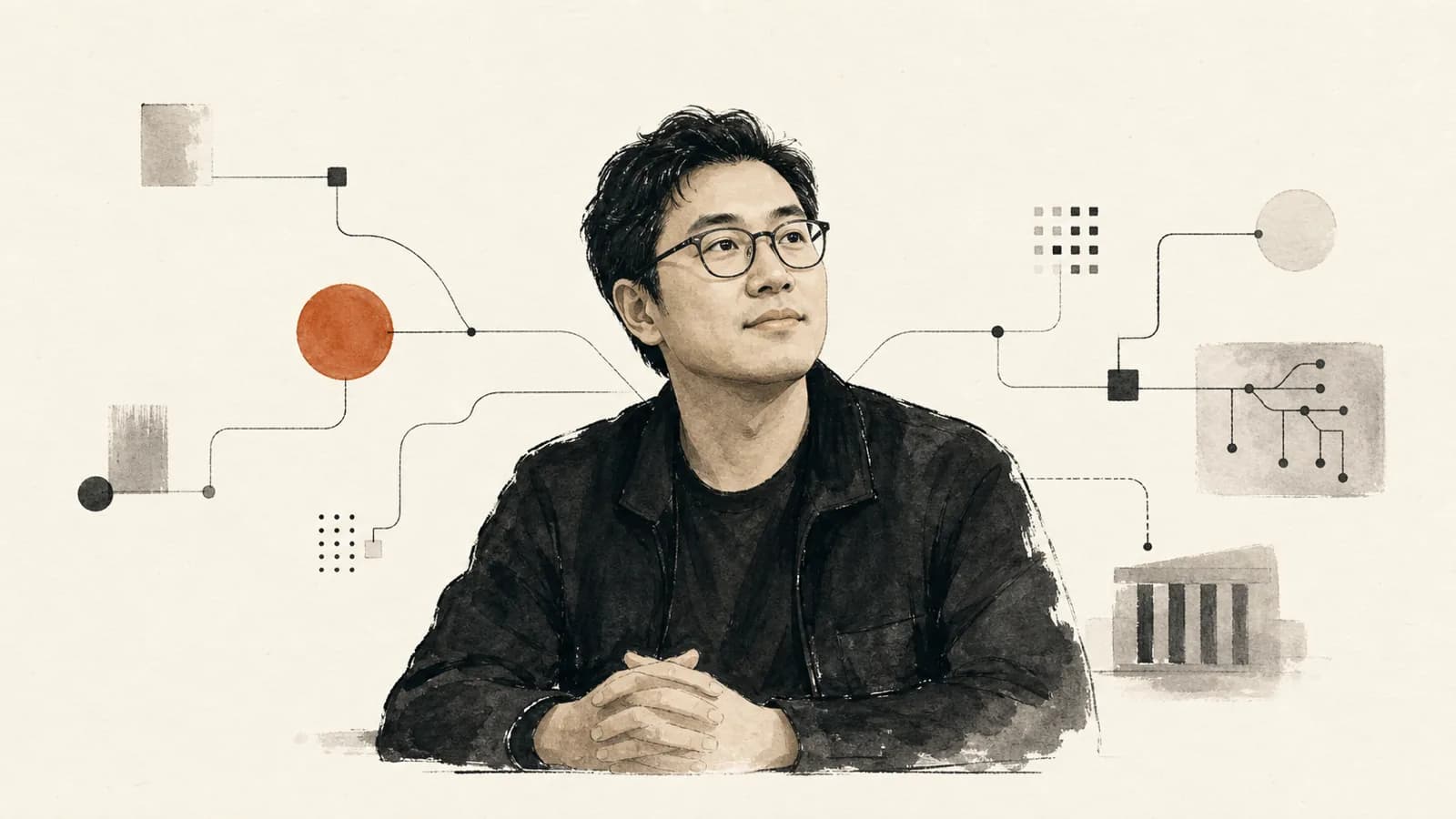
President & CEO of Y Combinator; previously a YC partner (from 2011), co-founder of Initialized Capital, and before that a designer-engineer (Posterous co-founder, early Palantir). His July 2026 AI Engineer talk The New Physics of Business is the wiki's YC-side account of the AI-Native Organization: he presents himself as a founder-investor "running a 20-year-old institution that is becoming AI native right now," with YC itself as the case study — media, events, and finance staff building skill files and cron jobs, the whole firm running on an internal OpenClaw deployment plus a company brain, at "a staff that would look like a rounding error at any other comparable firm."
The 400x claim#
His stress-test-me number: in 2013, as a near-full-time engineer building YC's internal social network, he wrote ~14 usable logical lines of code a day (median-normal for the era's literature). In 2026, running YC full-time on fewer hours, he measures his output at ~400x — self-deflated, assuming maximal verbosity and scaffolding penalties, to "8x at the floor and 80x in the middle." The load-bearing half of the claim is the attribution: "It's not the model. The 2x people and the 100x people are using the exact same Claude… the leverage is not in the weights, it's in how you wire the work" — the practitioner statement of Organizational Complements to AI, and a number to weigh against the measured expertise premium in Returns to Expertise in Agentic Coding (2× actions, 5× output per prompt).
GBrain and the company brain#
His open-source project (MIT-licensed, built in the open): a company brain — "the library plus the librarian," "effectively Postgres for agents" — a retrieval layer whose job is deciding, per task, "what three books should be loaded into the agent's head" (his working-memory image: an agent holds ~a million tokens ≈ three Harry Potter books, against the human 7±2). His personal instance: ~220,000 pages compiled mostly by his agents from email, meetings, and 20 years of notes. Failure modes he names himself: "a brain nobody curates becomes a garbage dump with great search"; the primitive is "memory plus hygiene" — provenance on every fact, contradiction checks, a human-plus-agent librarian whose job is pruning. This is an in-the-wild sibling of the Karpathy pattern this vault runs on — see LLM-as-Compiler Knowledge Base. His stated reason for open-sourcing: "the layer should be open the way Linux is open"; company brains and personal context are "wide open territory" he wants to fund at YC.
External placement: mem0's "State of Agent Wikis" survey (2026-07-21, practitioner-opinion) lists GBrain as one of the four canonical implementations of Karpathy's agent-wiki pattern — alongside Cognition's DeepWiki, Factory's AutoWiki, and LangChain's OpenWiki — as its minimal-infrastructure member: "It has no vector database. It has no service. It has files." (corpus: personal sources; currency: manual or scheduled runs; written for "a person and their agent"). The survey's personal-scale framing sits a step below Tan's own company-brain presentation; the two agree on the artifact and differ on the ambition.
"Own Your Intelligence" (Startup School, August 2026)#
His second wiki-indexed talk, three weeks after the first, keeps the architecture and adds the politics. Where New Physics of Business argued the AI-native org from the employer's side, this one argues personal AGI from the individual's: not "AGI as a singular event, a god in a data center" but general intelligence for one person, arriving diffused as "your agent running on your context, doing your work." The doctrine that follows — a skill file is externalized cognition, so whoever holds the repo holds your career capital — is treated on Owning Your Externalized Cognition.
Details this talk adds or updates:
- The rented/owned equation: a commoditizing frontier model + your context + a harness. He names OpenClaw, "Hermes agent," Claude Code and Codex interchangeably, and repeats the ecumenism with the same car metaphor inverted toward humility — "I always recommend the Ferrari, but the Honda is really good too… the upside of not-Ferrari is less getting out to fix it on the side of the road." A hosted GBrain is now free at gbrain.io; the agent-coding framework he cites as "G stack" is claimed at 123,000 GitHub stars, "top 100 open source projects in the history of GitHub" (unverified, stated from stage).
- A concrete compendium receipt. Preparing this talk, he had his agent acquire three Spinoza biographies (~1,500 pages), read all three, and produce a dated chronology, an explicit list of every point where the three biographers disagree, verbatim quotes with chapter citations, and the ten most tellable moments ranked with delivery notes. He calls it a compendium skill and uses it daily — "a mega version of deep research, only deeper than anything the corporate AI products will give you." It is the most specific description in the corpus of what a personal research harness produces, and the disagreement-mapping step is the interesting part: it is contradiction surfacing as a deliverable rather than a hygiene chore.
- The five-step how-to and the adoption curve: pick a harness, start one folder of markdown (not an archive — "nobody builds the warehouse first, first you build one shelf"), write one skill file for the weekly task you hate most, wire it to a recurring job, and never do one-off work. His stated 90-day shape — week 1 a toy, week 4 the flywheel catches, week 12 a library that answers before you finish asking — with the honest rider that "most people who try this will quit in week two."
- Why he open-sourced it: "tools of the powerful should be given away." Every era has a private technology of leverage — literacy, then capital, now the harness-plus-library — and "when something that powerful stays private, you get a priesthood. When it gets given away, you get a renaissance."
- The Spinoza frame, which is the talk's spine rather than decoration: conatus (the striving to increase one's power to act) as the thing tooling amplifies, Spinoza's definitions of joy and sadness as power-of-acting rising or falling, and his refusal of both a stipend to keep quiet and a Heidelberg chair conditioned on not disturbing the established religion — Tan's analogy for a comfortable job where your judgment compounds in someone else's repo.
Signature positions#
- Never do one-off work. After any successful agent task, "skillify it" (he published a skill for this): "if you have to ask for something twice, you failed. The organization that captures what it learns gets smarter every single day. The one that doesn't wakes up every morning with amnesia." The normative form of Agentic Work Systematization.
- Model quality is rented; your brain is owned — context/memory as the durable asset over model access (Compounding Data Moat in one line).
- Latent vs. deterministic space as the master bug diagnostic — see Latent vs. Deterministic Space.
- Tool ecumenism with a ranking: "OpenClaw is the Ferrari… Codex is a really good Honda. It will do 90% of this." The concepts travel to any stack.
- Abundance politics: "Abundance is not a policy paper, it is shipped software"; job-loss fear is "a failure of imagination." His closing exhibit: a father who built an 80,000-markdown-file brain to reach the edge of what humanity knows about his son's rare epilepsy — "a father, a laptop, and a library."
Connections#
- AI-Native Organization — his central thesis: the org-primitive → markdown mapping, YC's own transformation, the revenue-per-head claims
- Emergent — his headline revenue-per-head exhibit; now a third-party-checked $1.5B unicorn (TechCrunch, July 2026), which corroborates the company's scale while showing the record per-head figure compresses (~$600K/head at 200 staff vs the ~$1M/head of his "15 people at $15M" claim) — and disagrees with his "Summer 24" origin
- Latent vs. Deterministic Space — his engineering diagnostic, from the same talk
- LLM-as-Compiler Knowledge Base — GBrain as an in-the-wild company-brain instance of the compiled-wiki architecture, with a matching hygiene doctrine
- Agentic Work Systematization — "never do one-off work / skillify it" is the discipline whose adoption curve that page measures
- Founder as Agent Orchestrator — the role he prescribes to every YC founder and generalizes to non-engineering staff
- OpenClaw — YC's internal harness; "the Ferrari" in his tool ranking
- Owning Your Externalized Cognition — his sharpest normative claim, and the one with no measurement behind it: skill files are externalized cognition, so own them or "your job becomes a skill file"
Sources#
- The New Physics of Business — Garry Tan, Y Combinator — "The New Physics of Business," AI Engineer, 2026-07-17 (
practitioner-opinion; machine transcript) - Garry Tan: Own Your Intelligence — "Own Your Intelligence," YC Startup School 2026, published 2026-08-06 (42 min,
practitioner-opinion; cleaned from YouTube auto-captions, so exact wording is ASR-derived — an official transcript exists at ycrootaccess.com). The personal-AGI framing, the ownership doctrine, the compendium-skill receipt, the five-step how-to, and the GBrain/gbrain.io updates - The State of Agent Wikis — mem0, In Context #17 (2026-07-21,
practitioner-opinion): GBrain's placement among the four canonical agent-wiki implementations
Cited by 27
- Agentic Work Systematization×3
Ai Native Organization — Tan's org thesis built on this margin: skills as the org's encoded roles,…
- LLM-as-Compiler Knowledge Base×3
Garry Tan — GBrain as the organizational-scale sibling (library + librarian, memory-plus-hygiene);…
- Agent Context Files×2
Owning Your Externalized Cognition — the property question attached to the same artifact: Tan's…
- AI-Native Organization×2
Garry Tan's thesis (AI Engineer talk, July 2026, practitioner-opinion): the components of an…
- Compounding Data Moat×2
Llm As Compiler Knowledge Base — the moat as a knowledge store: Tan's "model quality is rented, but…
- Emergent×2
Garry Tan — the investor-evangelist who made Emergent his "new physics of business" exhibit; Y…
- Latent vs. Deterministic Space×2
Garry Tan's design discipline for agent systems (practitioner-opinion): be deliberate about where…
- OpenClaw×2
An institution-scale harness. Per Garry Tan (July 2026), Y Combinator runs internally on OpenClaw…
- Owning Your Externalized Cognition×2
Garry Tan's Startup School 2026 keynote (practitioner-opinion) makes an argument the rest of his…
- Agent Harness Engineering
Latent Vs Deterministic Space — Tan's two-sided diagnostic names the boundary harness design…
- AI Employee Framing
Ai Native Organization — the sharpest new tension surface: Garry Tan's "workforce made of markdown"…
- AI Investment Story, Not Efficiency Story
Ai Native Organization — the tail exhibits, argued from stage: Tan's Emergent (~$15M ARR at 15…
- AI-Native Startup Lifecycle
Ai Native Organization — the YC-side companion thesis: Tan's org-primitive mapping (skills /…
- AI Product Economics Maturation
Ai Native Organization — the org-restructuring half of this deck (flatter orgs, role-mix shift,…
- Andrej Karpathy
The gist became a category. Within roughly three months of its April 2026 publication, four…
- The Committed-Artifact Chain
Ai Native Organization — Tan's markdown-as-org-primitive mapping reaches the same substrate from…
- Evals as Product Spec
Ai Native Organization — evals applied to the org's own routing layer: Tan's "trigger evals" (does…
- Founder as Agent Orchestrator
Ai Native Organization — Tan's generalization past the founder: at YC "everyone is a manager of…
- Harness Shrinkage as Models Improve
Every source above treats shrinkage as an instruction to delete. Garry Tan's Startup School 2026…
- Implementation Abundance Inverts Product Work
Ai Native Organization — the same inversion stated as founder advice: with the tool nearly free to…
- Entities — People, Orgs, Tools & Projects
Garry Tan — President & CEO of Y Combinator; founder-investor turned evangelist for the AI-native…
- Non-Malleable Memory Authority (TMA-NM)
Llm As Compiler Knowledge Base — the benign-curation face of the same requirement: Tan's…
- Organizational Complements to AI
Ai Native Organization — the practitioner restatement: Tan's "the leverage is not in the weights,…
- Printing Press Software Democratization
Ai Native Organization — the thesis observed inside one institution: Tan's YC finance staffer…
- Returns to Expertise in Agentic Coding
Ai Native Organization — the practitioner-side amplification claim to weigh against this data:…
- Software 3.0
Latent Vs Deterministic Space — Tan's practitioner rule for the open question below: put judgment…
- The Tragedy of the Cognitive Commons
Owning Your Externalized Cognition — the same asset's other failure mode, and it aggravates this…
Related articles
- AI-Native Organization
Garry Tan's org-design mapping: skill files = employees, resolver tables = org charts, filing rules = process, trigger…
- Harness Shrinkage as Models Improve
Prompt scaffolding shrinks each model release; Cat Wu's pruning discipline; Boris Cherny "100 lines of code a year from…
- Owning Your Externalized Cognition
Garry Tan's ownership axis on skill files: once your judgment is written down as executable markdown it is an asset wit…
- Claude Code
Anthropic's agentic coding product; created by Boris Cherny late 2024; TypeScript/React on Bun (itself Claude-rewritten…
- Compounding Data Moat
Anthropic's prescription for Scale-stage defensibility: time-locked behavioral fingerprint + domain-encoded edge cases…