資料來源#
- Gemma 4 Technical Report
- Inkling: Our Open-Weights Model
- Interaction Models: A Scalable Approach to Human-AI Collaboration
- Kimi K3 Model Card
- Toward Native Multimodal Modeling: A Roadmap
- Tuna-2: Pixel Embeddings Beat Vision Encoders for Multimodal Understanding and Generation
摘要#
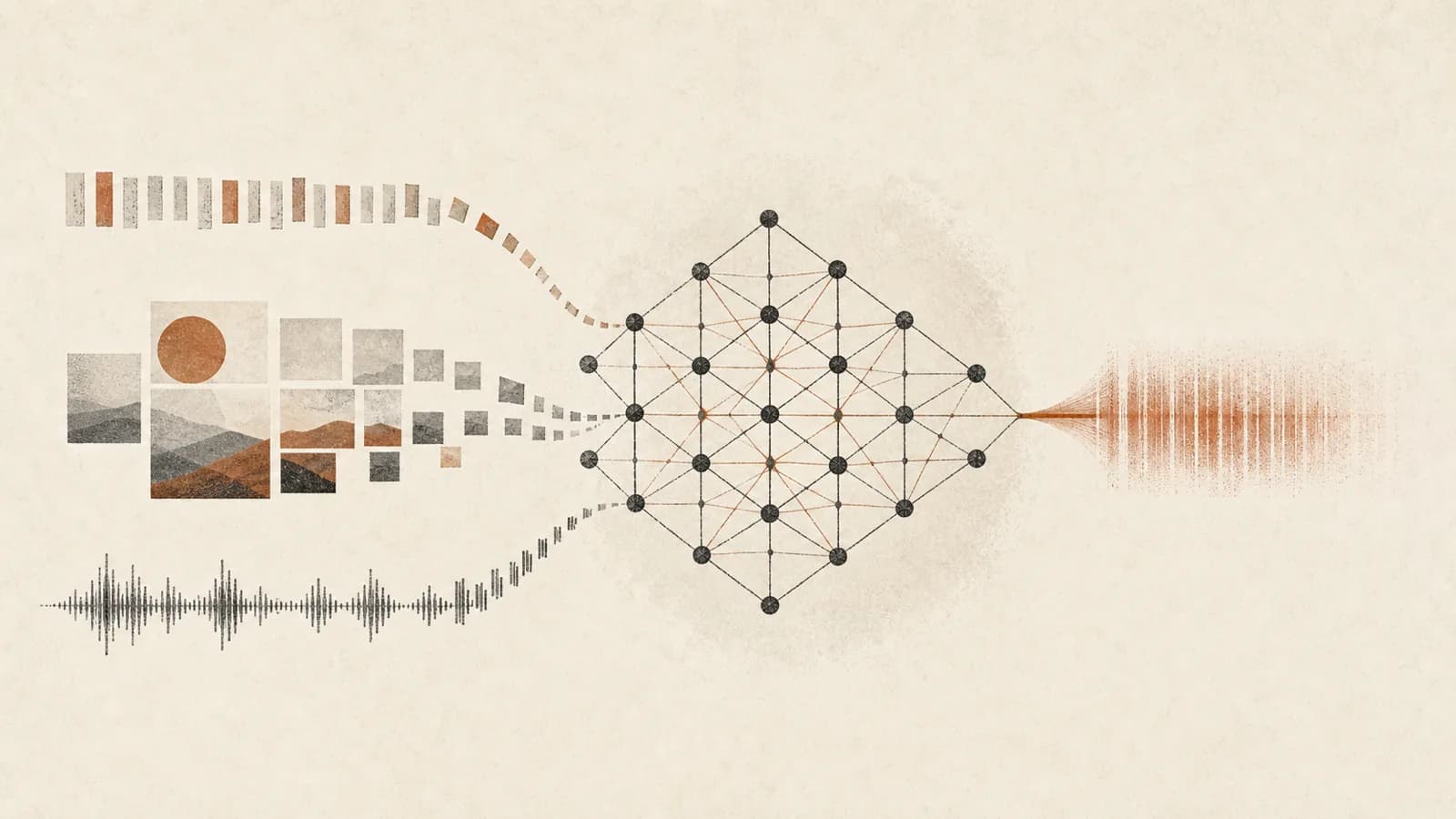
這是 Interaction Models 中的一項多模態設計選擇:不將音訊和影片送入大型獨立編碼器(再透過另一個類似 TTS 的解碼器輸出音訊),而是採用最少前處理,並使用從頭開始共同訓練所有元件的單一 transformer。「不使用編碼器」是相對而言——仍有輕量 embedding 層——但沒有 Whisper 規模的音訊編碼器,也沒有獨立的 TTS 模型。
元件(每個 200ms micro-turn)#
輸入(文字/畫格/音訊的任意子集):
- 文字 → token embedding(標準做法)。
- 影像/影片畫格 → 切分為 40×40 patches,由 hMLP 編碼(Touvron et al. 2022)。
- 音訊 → 以 dMel 輸入(Bai et al. 2024),再由輕量 embedding 層(「embedding 袋」)轉換。
單一共用的 Transformer 接收融合後的輸入。
輸出:
- 文字 → unembedding(標準做法)。
- 音訊 → flow head(Lipman et al. 2022)產生 mel。
所有元件都與 transformer 一起從頭共同訓練——不是把預訓練編碼器/解碼器拼接起來。
為什麼重要#
- 避免大型獨立編碼器/解碼器的延遲與複雜度——每 200ms 就必須執行一次時尤其重要(見 Time-Aligned Micro-Turns)。
- 早期融合(所有內容進入同一個 transformer)表示模型會跨模態共同推理,而不是只處理編碼器預先消化的輸出——這是邊說話邊對視覺線索做出反應等能力的先決條件(見 Full-Duplex Interaction)。
- 從頭共同訓練符合 The Bitter Lesson:減少人工設計的模組邊界,讓端到端學習發揮更多作用。
獨立佐證:Gemma 4 12B(2026 年 7 月)#
上面的設計依據單一來源、單一實驗室。Gemma 4(empirical)從不相關的出發點得出相同架構——而這類共識更值得關注,因為背後的動機不同。
TML 移除編碼器,是為了達到 200 ms 延遲預算。DeepMind 移除編碼器,則是為了節省記憶體:「減輕對獨立編碼器的需求,並減少邊緣硬體上的記憶體碎片化」。結論相同,理由彼此獨立。當兩個以不同目標最佳化的實驗室都決定刪除同一元件,該元件大概就不是不可或缺的。
Gemma 4 12B 的實作方式:
- 視覺。 48×48×3 RGB patches 經由單一 35M 矩陣乘法處理,取代 550M ViT。在最終 LayerNorm 之前,會將以 2D 座標為基礎的位置 embedding 加到 patch 表徵上。
- 音訊。 305M、以 USM 為基礎的 conformer 完全捨棄。原始 16 kHz 音訊切成 40 ms 區塊——每個是 640 維向量——再直接投影到 LLM embedding 空間。完全不加入位置編碼:音訊本身已是時間序列。
Table 8 是證據。無編碼器的 12B 在英文 FLEURS ASR 達到 0.063 WER,在 CoVoST de→en 達到 41.9 CorpusBLEU;搭載編碼器的 E4B 則分別為 0.065 和 42.0。就這些數字而言,丟掉 305M conformer 毫無代價。DeepMind 自己的說法是:「不需要專用音訊編碼器,也能達到具競爭力的音訊文字表現。」
報告未提及的兩項但書#
這不是受控消融實驗。 無編碼器模型是 12B;搭載編碼器的比較對象則是有效規模 4.5B 的 E4B。12B 有更多 LLM 容量,可以承接原本由捨棄的編碼器處理的工作。論文支持「不使用編碼器也能達到具競爭力的表現」這項主張;但並未在任何地方測試更強的主張——「移除編碼器不花任何代價」;要確認這點,應比較相同規模的模型,而論文並未這麼做。(如今不同實驗室已有相同規模的比較組,而且只涵蓋視覺——見下方 Tuna-2 章節。結果比「沒有代價」更有力:在 7B 規模下,無編碼器比較組理解表現更好,生成表現更差。)
存在經測量的退步,而且情況很特定。 將視覺 token 從 1120(Table 6)減至 280(Table 12),12B 的退化幅度不符合規模排序:
| Model | InfographicVQA Δ | OmniDocBench 1.5 Δ(↓ 越好) |
|---|---|---|
| 31B | −9.2 | +0.070 |
| 26B-A4B | −11.5 | +0.120 |
| 12B(無編碼器) | −29.7 | +0.244 |
| E4B | −15.2 | +0.126 |
| E2B | −19.3 | +0.206 |
12B 的退步比比它大、也比它小的模型都嚴重——這是整個系列唯一違反排序的案例,而且它也是唯一不使用編碼器的成員。這種影響僅出現在影像中的密集文字任務:MMMU Pro(−1.4)和 MATH-Vision(−3.0)的退化程度符合常態。一種合理解讀是,35M 的線性投影不會壓縮特徵,因此模型必須提高解析度,補上 ViT 原本用參數處理的部分。讀取小字因此會受 token 預算限制。
若這種解讀正確,不使用編碼器就不是免費的——而是以視覺 token 換取編碼器參數,屬於推論成本的取捨,而非單純節省。報告既未呈現也未評論這種反轉。(部分結論已於 2026-09-21 被 Tuna-2: Pixel Embeddings Beat Vision Encoders for Multimodal Understanding and Generation 更新:同規模 7B 消融顯示,僅使用投影的路徑在 OCRBench 領先,因此密集文字不必然需要編碼器。參數換 token 的解讀仍可解釋 Gemma 4 為何恰好在 280 tokens 時出現斷崖式退步——Tuna-2 從未掃描 token 預算,因此無論哪種解釋,機制都尚未測試。Tuna-2 確認的是另一種並非免費的代價:無編碼器比較組需要額外的 masking objective,而且在約 2T token 以前或 1.5B backbone 上表現較差。)
第三個實例:975B 規模的 Inkling(2026 年 7 月)#
Inkling(vendor-claim)把這項設計從 276B 研究預覽版和 12B 邊緣模型,延伸到 975B 開放權重基礎模型:音訊使用 dMel 頻譜圖,影像使用 40×40 像素 patches,並經過四層 hMLP;兩者都透過輕量 embedding 層「與文字 token 一起處理」,以一般領域資料從頭訓練——TML 明確表示這種選擇「符合互動模型設計」。由於與第一個實例出自同一實驗室,這是規模延伸,而非新的獨立佐證;但它回答了前兩個實例留下的問題:當預算足以採用任何架構時,不使用編碼器的輸入是否仍然可靠?TML 表示 Inkling 是最強大的開放權重音訊模型之一(VoiceBench 91.4、MMAU 77.2、AudioMC 56.6;它所比較的開放全能專家模型為 24–38),在圖表/圖解視覺理解上也表現出色(CharXiv RQ 78.1)。三個實例仍都沒有提供同規模的使用編碼器/不使用編碼器消融——下方的開放問題依然成立。
反例:Kimi K3 在 2.8T 規模保留編碼器(2026 年 7 月)#
前三個實例看法一致;第四個資料點則提出異議,而且它是四者中規模最大的模型。Kimi K3(vendor-claim)是由 401M MoonViT-V2 視覺編碼器搭載的 2.8T/104B 開放 MoE——一個專用的獨立視覺塔,在沒有外力迫使其做出選擇的規模下仍刻意保留。它不是有記憶體上限的邊緣模型,也不是受延遲限制的互動模型;Moonshot 有足夠預算採用任何架構,卻選擇了本文所記錄的、其他實驗室正逐漸放棄的架構。
關鍵比較在於它在哪裡勝出。不使用編碼器的 12B 唯一經測量的退步,是影像中的密集文字——InfographicVQA 下滑 29.7 分,也是該系列唯一違反規模排序的案例——提出的解釋是,僅投影的路徑不會壓縮特徵,因此必須用解析度補足參數。K3 在本語料庫中恰好是這類任務表現最強的模型:OmniDocBench 91.1,在其自身 45 組模型比較表中名列第一(高於 Fable 5 的 89.8);在 OfficeQA Pro 上則達 63.3,該測試的設定是「每個測試案例都會提供完整 PDF 語料庫,所有 PDF 都以影像呈現,且不提供機器可讀文字」。同時,它在視覺感知與推理基準上落後於 Fable 5(WorldVQA 51.0 vs 56.7、BabyVision 85.7 vs 90.5、CharXiv 84.8 vs 88.9)——這與「編碼器只是提供通用視覺能力」的預期剛好相反。
這項證據應該讓你改變多少看法:不多;理由值得直接說明,而不是急著下定論。 這不是下方第一個開放問題要求的同規模消融實驗,而是不同實驗室、不同規模、不同訓練語料,以及供應商自己的數據。這些資料沒有顯示移除 MoonViT-V2 會讓 K3 損失任何表現,Gemma 4 的資料也沒有顯示加入編碼器就能挽救其 12B。四個實例共同確立的結論,比「不使用編碼器就是贏家」更有限,也更有用:在約 1T 的前沿規模,這個領域尚未形成共識。 TML 在 975B 移除編碼器,Moonshot 則在 2.8T 保留編碼器,而且兩者在同一個月都回報了出色的視覺表現。應把「不使用編碼器是趨勢」視為兩家實驗室的觀察(TML 與 DeepMind),而非整個領域的定論。
有一項不對稱的觀察仍成立:這裡每個不使用編碼器的實例都同時移除了音訊編碼器,而 K3 完全沒有音訊路徑(只有文字和影像)。不使用編碼器最有力的證據——Gemma 4 的 Table 8 顯示捨棄 305M conformer 只讓 WER 差了 0.002——來自音訊,而 K3 並未對此提出異議。
終於有同規模比較組:7B 規模下的 Tuna-2 與 Tuna-R(2026 年 4 月)#
上述每個實例都是拿無編碼器模型與另一個模型比較——規模不同、實驗室不同,或訓練流程不同。Tuna-2(Liu et al.,Meta FAIR + HKU + Waterloo,arXiv 2604.24763,empirical)是本語料庫中第一個執行下方開放問題所要求之比較組的來源:兩個統一多模態模型,唯一差異在視覺路徑中是否採用預訓練視覺編碼器。
- Tuna-R——Qwen2.5-7B-Instruct decoder + SigLIP 2 So400M 表徵編碼器 + connector(LLaVA 架構,且 VAE 已移除)。
- Tuna-2——相同的 Qwen2.5-7B-Instruct decoder,在原始像素上使用 patch size 16 的單一 patch embedding 層,除此之外沒有其他元件。沒有 VAE、沒有表徵編碼器,只有一個 transformer。
兩者都能做理解和像素空間影像生成(rectified-flow、採用 JiT 風格 x-prediction 並搭配 v-loss),因此單一消融實驗涵蓋了設計的兩個部分。
哪些條件相同。 第一階段預訓練:使用相同的 550M 內部影像文字配對資料,生成與理解的抽樣比例為 7:3(7g3u,比例本身也是透過消融選定),並以 Nemotron 文字資料佔混合資料的 20%;在 64 個節點訓練 300k steps,AdamW 設為 1×10⁻⁴,每個 GPU 的序列補齊至 16k tokens;預訓練最後 40% 階段使用 masking objective(50% 範例,mask ratio 隨機取樣自 0–50%)。第二階段 SFT:使用相同語料(13M FineVision 對話 + 約 2M OmniEdit 編輯資料),以 2×10⁻⁵ 訓練 50k steps。基準套件與測試流程也相同。
哪些條件不同——而且三項不對稱都對使用編碼器的一方有利。
- Tuna-R 多了約 400M 個參數(SigLIP 2 So400M)和一個 connector。兩列都標示為「7B」;無編碼器模型其實是較小的那一個。
- Tuna-R 多了一個Tuna-2 沒有的訓練階段:第一階段之前,以 5×10⁻⁴ 進行 3k connector 對齊步驟。論文的說法是,無編碼器設計「不需要這個額外階段」。
- 計算量是以 steps 而非 FLOPs 或視覺 token 數量匹配。兩個比較組的視覺 token 數都沒有報告,而且 patch-16 像素路徑和 SigLIP 路徑產生的序列長度不同。此處的「同規模」是指 backbone 和資料相同,並非計算量相同。
讀取表格前,還應先說明第四項限制:Tuna 這一列引用自較早論文,並非重新執行的結果,因此只有 Tuna-R ↔ Tuna-2 配對是乾淨的受控比較。Tuna 是參考點,而非第三個比較組。
結果(Table 1;所有數值均從 pdftotext -f 6 -layout 還原——docling 解析完全漏掉這些列,詳見 Sources 的解析警告)。
| Benchmark | Tuna(VAE + 編碼器) | Tuna-R(編碼器) | Tuna-2(無編碼器) | 與 Tuna-R 的差異 |
|---|---|---|---|---|
| GQA | 63.9 | 63.5 | 65.0 | +1.5 |
| RealWorldQA | 66.1 | 67.9 | 67.7 | −0.2 |
| MMVet | 42.9 | 46.7 | 51.7 | +5.0 |
| MMMU | 49.8 | 51.1 | 50.7 | −0.4 |
| MMVP | 70.7 | 74.7 | 77.3 | +2.6 |
| SEED-Bench2+ | 52.7 | 58.4 | 61.1 | +2.7 |
| AI2D | 79.3 | 79.4 | 79.6 | +0.2 |
| ChartQA | 85.8 | 85.6 | 85.6 | 0.0 |
| OCRBench | 74.3 | 78.3 | 79.7 | +1.4 |
| V* | 52.4 | 57.6 | 59.2 | +1.6 |
| CountBench | 73.5 | 77.8 | 81.7 | +3.9 |
| VisuLogic | 22.4 | 26.2 | 28.8 | +2.6 |
在 backbone 和資料相同的條件下,無編碼器模型有 10 項中的 12 項勝出,而且模型規模更小、少一個訓練階段。輸掉的兩項分別只差 0.2 和 0.4 分。最大進步正是摘要所提到的細粒度感知(MMVet +5.0、CountBench +3.9、SEED-Bench2+ +2.7、MMVP +2.6)。
密集文字方面的預測並未重現。 上方 Gemma 4 章節預測,僅投影的視覺路徑本身就應該在 InfographicVQA 出現斷崖式退步。但在同規模比較中,無編碼器模型在每一項密集文字基準上都名列第一或並列第一:OCRBench 79.7 vs 78.3、AI2D 79.6 vs 79.4、ChartQA 85.6 vs 85.6。兩項但書意味著這不能算是乾淨的反駁。基準套件不含 InfographicVQA、DocVQA 或 OmniDocBench——也就是 Gemma 4 的 12B 退步最明顯的基準;更重要的是,沒有視覺 token 數量測試:Gemma 4 的 −29.7 只在 token 從 1120 降到 280 時出現,而 Tuna-2 全程只用一種 token 預算。因此被推翻的是強版本的說法(「僅投影路徑本質上不擅長處理密集文字」);本文提出的 token 預算機制仍未受到影響,也未經測試。
生成表現則呈現相反方向,而且結果一致。 語意先驗在有幫助之處,編碼器就能帶來優勢:
- GenEval overall:Tuna 0.90 / Tuna-R 0.88 / Tuna-2 0.87。DPG-Bench overall:86.76 / 86.35 / 86.54。
- ImgEdit total:Tuna 4.31 / Tuna-R 4.18 / Tuna-2 4.09——無編碼器模型在三者中墊底。
- 對 1.5K 個提示詞、每個提示詞生成 4 張影像進行 LLM-judge 三選一比較(Table 3):在品質方面,兩個評審都認為 Tuna-2 落後於 Tuna-R(GPT-5.4 為 32.1% vs 35.7%;Claude Opus 4.7 為 34.8% vs 37.2%);但在多樣性方面,Tuna-2 以明顯差距勝出(48.4% vs 30.9%;41.9% vs 29.9%)。
- 輕量微調後的影像重建(ImageNet val):Tuna-R 的 rFID 0.12/PSNR 32.22,Tuna-2 的 rFID 0.15/PSNR 32.80,兩者 SSIM 都是 0.93——在統一 tokenizer 中排名第一,完全不使用 VAE,表現已接近 FLUX.1[dev] 的 VAE(0.06 / 33.65 / 0.93)。
「達到規模」指的是訓練規模,不是模型規模——而小規模比較組的結果正好相反。 Figure 6 繪出準確率與訓練 token 數(0T → 3T)*的關係。在早期階段,Tuna-R 在三項理解基準上都領先;OCRBench 約在 2T tokens 時交叉(在 1T→3T 的區間中,Tuna-R 約為 71.5 → 71.5,Tuna-2 約為 65.7 → 73.2),V 情況相似,MMVP 則稍早交叉。在 GenEval 上,Tuna-R 在整個預訓練期間都領先,直到 SFT 後兩者才趨於一致。Table 6 的消融結果正好與此相反:使用 Qwen-2.5-Instruct-1.5B backbone 訓練 100k steps 時,無編碼器模型樣樣落敗:OCRBench 56.8 vs 59.2、MMVP 55.7 vs 58.0、CountBench 57.6 vs 58.2、GenEval 48.2 vs 56.0。因此研究發現不是「不使用編碼器就會贏」,而是「backbone 夠大且預訓練 token 夠多時,不使用編碼器才會贏;低於這個門檻就會輸。」** 編碼器提高了樣本效率,而這項優勢會逐漸折舊。
Masking objective 對無編碼器模型特別關鍵。 同一個 Table 6 比較開啟與關閉 masking:Tuna-R 的增益為 +0.9 / +1.3 / +1.0 / +0.3(OCRBench / MMVP / CountBench / GenEval);Tuna-2 則增加 +1.4 / +3.4 / +4.2 / +0.6。作者的解釋是,SigLIP 2 本來就使用 masked-prediction objective 預訓練,因此 Tuna-R 已經內建此能力。實際上的解讀是:移除編碼器並非毫無代價——還得額外加入一項訓練目標,才能補回編碼器提供的部分能力。
論文的「state-of-the-art」說法掩蓋了一項校準資訊。 這項主張指的是 SOTA 限於 ≤13B 的原生統一模型,並非所有 7B 多模態模型。在 Table 1 的比較列中,僅用於理解的 Qwen2.5-VL 7B 在 12 項基準中的 8 項勝過 Tuna-2(OCRBench 83.7 vs 79.7、V* 71.2 vs 59.2、MMMU 58.6 vs 50.7、MMVet 61.7 vs 51.7、SEED-Bench2+ 70.5 vs 61.1、AI2D 82.7 vs 79.6、RealWorldQA 69.9 vs 67.7、MMVP 78.0 vs 77.3);Tuna-2 只在 GQA、ChartQA、CountBench 和 VisuLogic 領先。移除編碼器在統一模型設計內有所幫助,但不表示統一模型是讀取影像的最佳方法。
這對上方各頁的結論。 這是僅限視覺、僅限影像的結果:Tuna-2 完全沒有音訊路徑,因此最有力的無編碼器證據(Gemma 4 的音訊 Table 8)既未獲得佐證,也未被反駁。規模也只有 7B,遠低於 TML 和 Moonshot 出現分歧的約 1T 規模。而且兩個比較組都是從預訓練文字 LLM 起步,並非從頭訓練——正因如此,它對下方第三個問題具有決定性。
一項新定義讓本文標題分成兩個概念(2026 年 5 月)#
An, Lu, Dong et al.(Tencent Youtu Lab + 5 所大學,arXiv 2605.25343,practitioner-opinion)是本語料庫中第一個以正式定義而非舉例說明「原生」的來源——但這項定義並不符合本文一直以來使用「early fusion」的方式。
這份調查的分類軸線是tokenization 發生在哪裡,而不是有沒有編碼器:
- Mid-fusion——
Backbone(C(E₁(m₁), …, Eₙ(mₙ))),將編碼器特徵透過 cross-attention 或 adapter 運算子C注入 backbone 的中間層。這種架構會因應模態而異,編碼器在架構上與 backbone 不同。*是否可訓練與分類無關:*即使 mid-fusion 模型中的編碼器完全解凍,它仍然是 mid-fusion。 - Early-fusion——
Transformer(⋃ᵢ T(mᵢ)),使用一個統一的 tokenization 運算子T,從一開始就把所有模態映射到同一個共用空間。
調查並未用「無編碼器建模」來命名上述任一架構。它出現在低兩個層級:這是M2M 模態特異性保留陣營為化解理解與生成兩難而採用的兩種策略之一,另一種是「實體解耦」——例如 Janus-Pro 的理解/生成分離編碼器,以及 BAGEL 的 Mixture-of-Transformer-Experts。調查列出的無編碼器實例是 Tuna-2 和 SenseNova-U1。依照這種解讀,本文一直在同一個標題下主張兩件事:移除編碼器(參數配置選擇,也是以上各節實際測量的內容),以及早期融合(tokenization 路徑選擇,以上各節都沒有單獨檢驗)。T 完全可以是學得的離散 tokenizer;Chameleon/AnyGPT/Emu3.5 正是調查列出的典型 early-fusion 模型,因為它們採用 codebook——與原始 patch 投影位於設計空間的另一端。這是定義更精確了,並非研究發現;調查沒有測量任何事物。
這份調查中有兩處缺漏值得記錄,因為它是一份普查。 Gemma-4 的列出模型是 31B 和 E4B,而它把 Gemma-4-31B 歸類為以視覺編碼器為基礎的融合——承載本文最有力證據的 12B——捨棄 305M conformer 的模型——完全沒有出現在 Table 1 或分類圖中。 因此,這份調查既未佐證也未反駁 Gemma 4 的音訊結果;它整理的是該系列的另一部分。互動模型系列也完全沒有出現(TML-Interaction-Small、Inkling),因為這份普查僅收錄開源模型與技術報告,且要求「架構與參數透明度經過驗證」。
這份調查確實補上了一項有實質意義的資訊:其 Table 1 將 Tuna-2 記為 continuous(沒有離散統一星號),這與上方同組比較的結果一致,也排除了「Tuna-2 的優勢來自量化,而非移除編碼器」這種解讀。
延伸閱讀#
- Native Multimodal Modeling: Fusion Depth and I/O Duality — 正式定義將early-fusion(一個 tokenizer 映射到一個空間)和無編碼器建模(M2M 模態特異性保留中的一項策略)區分開來;其普查未收錄無編碼器的 Gemma-4 12B
- Interaction Models — 上位概念
- Time-Aligned Micro-Turns — 為什麼最少前處理是硬性要求(200ms 預算)
- Interaction / Background Model Split — 架構的另一部分
- Full-Duplex Interaction — 跨模態共同推理使視覺與音訊插話成為可能
- The Bitter Lesson —「從頭共同訓練,移除模組化編碼器」是苦澀教訓式的做法
- TML-Interaction-Small — 實作此設計的模型(dMel 音訊、40×40 hMLP patches、flow head),從頭共同訓練
- Gemma 4 — 第二個獨立實例:一個直接完全捨棄 305M 音訊 conformer 的 12B 開放權重模型
- Inkling — 第三個實例:在 975B 開放權重規模採用此設計,理由是符合互動模型的設計方向
- Inference Efficiency as Capability — DeepMind 的動機是記憶體而非延遲;密集文字方面的退步也暗示,節省的其實是參數換 token
- The Open-Weight Frontier Gap — 移除編碼器是小型 dense 模型得以參與競爭的手段之一
- Kimi (Moonshot AI) — 反例:保留 401M MoonViT-V2 編碼器的 2.8T 模型,在密集文字影像任務上領先整個語料庫;無編碼器的 12B 正是在這些任務上退步
開放問題#
- 同規模下,無編碼器模型仍能匹敵嗎? TML 從頭共同訓練所有元件;Gemma 4 在四個模型上凍結編碼器、只在一個模型上移除編碼器,且規模不同;Kimi K3 在 2.8T 保留 401M 編碼器,並在密集文字視覺任務上領先。Tuna-2: Pixel Embeddings Beat Vision Encoders for Multimodal Understanding and Generation 已於 2026-09-21 提供部分解答:就視覺而言,在 7B 規模下使用相同 backbone(Qwen2.5-7B-Instruct)和相同資料,無編碼器模型不只是追平,表現還更好:在 12 項理解基準中,有 10 項勝過搭載編碼器的同型模型(MMVet +5.0、CountBench +3.9、OCRBench +1.4),而且參數少約 400M、少訓練一個階段;只有在 RealWorldQA(−0.2)和 MMMU(−0.4)落敗。這個問題仍有三個未解之處。消融實驗只有影像——Tuna-2 沒有音訊路徑,而原始證據真正所在之處是音訊:移除 305M conformer,WER 只差 0.002。規模只有 7B,比兩家實驗室意見分歧的規模小了整整一個數量級。生成方面,搭載編碼器的模型仍然勝出(GenEval 0.88 vs 0.87、ImgEdit 4.18 vs 4.09,以及兩個評審對品質的評價),所以「匹敵」只適用於理解,不適用於生成。
- 密集文字的退化是僅投影視覺路徑的固有現象,還是 12B 特定訓練流程造成的?這項預測可以被證偽:無編碼器的 31B 應該在 280 tokens 時也出現相同的 InfographicVQA 斷崖式退步。Tuna-2: Pixel Embeddings Beat Vision Encoders for Multimodal Understanding and Generation 已於 2026-09-21 提供部分解答,可分三部分評估。*問對了方向:*這個問題正確地質疑斷崖式退步是否只源自 12B 的訓練流程,也正確地把視覺路徑的表徵方式視為變因——7B 同規模比較正好隔離了這個變因,並得到明確結果。預測錯誤:「僅投影路徑本質上就有問題」這一支。與搭載編碼器的同型模型相比,patch-16 僅投影路徑在每一項密集文字基準上都最佳或並列最佳(OCRBench 79.7 vs 78.3、AI2D 79.6 vs 79.4、ChartQA 85.6 vs 85.6),因此閱讀密集文字並不需要編碼器。*理由不對,方向卻對:*本文提出的機制——投影不會壓縮特徵,因此必須用解析度補足參數,使密集文字受token 預算限制——仍未受到影響,因為 Tuna-2 只用一種 token 預算,從未掃描其變化,基準套件也不含 InfographicVQA、DocVQA 或 OmniDocBench。如今要判定此機制的證偽測試範圍更小、成本更低:對任何無編碼器模型進行視覺 token 數量測試,而非訓練 31B 模型。
已解決問題#
- TML 移除編碼器並從頭共同訓練。Gemma 4 移除編碼器,且 12B 是從頭訓練;但其他模型仍保留凍結的編碼器。「無編碼器 + 從頭訓練」兩項條件中,究竟是哪一項發揮作用?已於 2026-09-21 解答:至少對視覺路徑而言,發揮作用的是不使用編碼器,而且兩項條件可以分開。Tuna-2: Pixel Embeddings Beat Vision Encoders for Multimodal Understanding and Generation 的兩個比較組都以預訓練文字 LLM(Qwen2.5-7B-Instruct)初始化,因此沒有任何部分是從頭訓練;即便如此,無編碼器模型仍在 12 項理解基準中的 10 項勝過搭載編碼器的同型模型。因此,從頭共同訓練並非無編碼器優勢的先決條件。兩項補充資訊不會讓問題重開,但界定了適用範圍:這項優勢有規模條件,在 100k steps 的 1.5B backbone 上完全反轉(OCRBench 56.8 vs 59.2、GenEval 48.2 vs 56.0),而且約要等到 3T 預訓練 tokens 中的 2T 才會出現;移除編碼器還得付出額外 masking objective 的代價,無編碼器模型從中得到 +1.4/+3.4/+4.2,搭載編碼器模型則得到 +0.9/+1.3/+1.0。
資料來源#
- Interaction Models: A Scalable Approach to Human-AI Collaboration
- Gemma 4 Technical Report — §2.3(無編碼器架構)、Table 8(無編碼器音訊)、Tables 6 和 12(280-vs-1120 視覺 token 退化)(
empirical) - Inkling: Our Open-Weights Model — 975B 規模的 dMel + 4 層 hMLP、一般領域從頭訓練、音訊/視覺基準表(
vendor-claim) - Kimi K3 Model Card — §2 規格表(MoonViT-V2、401M、2.8T/104B 規模;模態為文字+影像)、§3 視覺資料(OmniDocBench 91.1、WorldVQA、CharXiv、BabyVision)及註腳 3(OfficeQA Pro 僅以影像提供 PDF 語料)(
vendor-claim)——反例 - Tuna-2: Pixel Embeddings Beat Vision Encoders for Multimodal Understanding and Generation — Liu et al.(Meta FAIR + HKU + Waterloo;arXiv 2604.24763,v1 2026-04-27,PDF v2 2026-05-18;
empirical)——同規模比較組。§2.1 三種架構階層(Tuna → Tuna-R → Tuna-2)、§2.2 masking objective、§3.1 兩個比較組共用的訓練方式以及兩項差異(SigLIP 2 So400M;3k 步驟的 connector 對齊階段)、§3.2 + Table 1 的 12 項基準理解比較、Tables 2–5 的生成/編輯/重建結果、§3.4 + Table 6 的 1.5B masking 消融、§3.5 + Figure 6 的 0T→3T 訓練規模曲線。**本文慣例中的解析警告:**docling 對 Table 1 的解析完全漏掉 Tuna/Tuna-R/Tuna-2 三列,並把 LLaVA/Qwen 基準組折疊為一列多值資料(25 個標記儲存格)——本文 Table 1 和 Table 2 的所有數字都從本機 PDF 的pdftotext -f 6 -l 7 -layout還原;Tables 3–6 也以同樣方式重新閱讀,並與 docling 本文逐格相符。Figures 1、5、6 均已檢視;Figure 6 的交叉點是從圖中讀取,並非取自文字。**COI:**與供應商有關聯——由 Meta 作者打造其後勝出的以編碼器為基礎的對照組;數據為作者自行回報,單一隨機種子,沒有誤差範圍;Table 1 的比較基準取自原始論文 - Toward Native Multimodal Modeling: A Roadmap — An, Lu, Dong et al.(Tencent Youtu Lab + Tsinghua/HKU/Warwick/Monash/PolyU;arXiv 2605.25343,2026-05-25;
practitioner-opinion,52 頁):§2.1 mid-fusion/early-fusion 運算子的定義、§3.3.2 將無編碼器建模列為 M2M 模態特異性保留中的一種策略、Table 1 的 Gemma-4-31B/E4B 資料列,以及 Tuna-2 沒有星號的(continuous)分類、Figure 4 中 Tuna-2 和 SenseNova-U1 的位置。本文僅採用其定義——調查沒有進行實驗,並在全文重述第三方結果。完整分析見 Native Multimodal Modeling: Fusion Depth and I/O Duality
Cited by 15
- Gemma 4×3
Encoder Free Early Fusion — Gemma 4 12B is the second independent instance of the design, and the…
- The Bitter Lesson×3
Encoder Free Early Fusion — co-train all modality components from scratch in one transformer rather…
- Google DeepMind×2
Gemma 4's 12B is also the second independent instance of Encoder Free Early Fusion, arrived at for…
- Inference Efficiency as Capability×2
5. Removing the encoders. The 12B's 550M vision encoder becomes a 35M matmul and its 305M audio…
- Inkling×2
Encoder-free multimodality: audio in as dMel spectrograms, images as 40×40-pixel patches through a…
- Interaction Models×2
Time Aligned Micro Turns, Interaction Background Model Split, Encoder Free Early Fusion — the three…
- Kimi (Moonshot AI)×2
K3 ships a 401M MoonViT-V2 vision encoder at 2.8T scale. Encoder Free Early Fusion documents three…
- Native Multimodal Modeling: Fusion Depth and I/O Duality×2
The vault reached "early fusion" from the interaction-model side and had been using it loosely as a…
- Open Questions Backlog×2
Encoder Free Early Fusion: Is the dense-text degradation intrinsic to a projection-only vision…
- TML-Interaction-Small×2
Modalities: continuous audio + video + text in; text + audio out. Encoder Free Early Fusion (dMel…
- Full-Duplex Interaction
Encoder Free Early Fusion — joint multimodal reasoning is what lets a visual change trigger speech
- Interaction / Background Model Split
Encoder Free Early Fusion — the other half of the architecture (the perception/generation side)
- Interaction & Multimodal
Encoder Free Early Fusion — Multimodal design with minimal pre-processing instead of large…
- The Open-Weight Frontier Gap
Encoder Free Early Fusion — one of the levers that lets a 31B dense model contend at all
- Time-Aligned Micro-Turns
Encoder Free Early Fusion — the complementary "minimal pre-processing" choice that makes streaming…
Related articles
- Interaction Models
Thinking Machines Lab (May 2026): models that handle audio/video/text interaction natively in real time instead of via…
- Interaction / Background Model Split
Dual-model architecture: a time-aware interaction model stays present while an async background model handles deep reas…
- Gemma 4
Google DeepMind's July 2026 open-weight multimodal family (Apache 2.0): 2.3B–31B dense plus a 26B/4B-active MoE, adding…
- Inkling
Thinking Machines Lab's first from-scratch open-weights family (July 2026): a 975B/41B-active multimodal MoE with 1M co…
- Native Multimodal Modeling: Fusion Depth and I/O Duality
An, Lu, Dong et al. (Tencent Youtu + 5 universities, May 2026) formalize 'native' as two operator definitions — mid-fus…